Three diluents, one job
A lyophilised peptide arrives as a freeze-dried solid and has to be dissolved before it can be used. The liquid it is dissolved in is the diluent, and three are in common use: bacteriostatic water, sterile water and dilute acetic acid. All three do the same basic job. They differ in what else they bring to the solution, and that is what decides which one suits the work.
Bacteriostatic water is often called bac water, and both it and acetic acid water are sometimes called peptide water. The informal names are worth knowing because they turn up in protocols and supplier listings, but they are not precise. The composition on the label is what counts.
Side by side
| Bacteriostatic water | Sterile water | Acetic acid water | |
|---|---|---|---|
| Composition | Water with 0.9% benzyl alcohol | Water only | Water with 0.6% acetic acid |
| Preservative | Yes, bacteriostatic | None | None as such |
| Vial accessed repeatedly | Designed for it | Single use | Depends on handling |
| pH | Close to neutral | Close to neutral | Acidic |
| Typical use | Default diluent for most peptides | Where a preservative is unwanted | Peptides that resist dissolving at neutral pH |
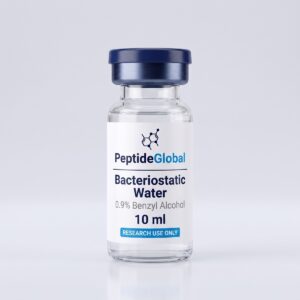
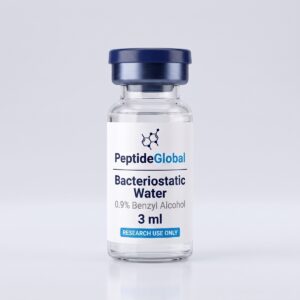
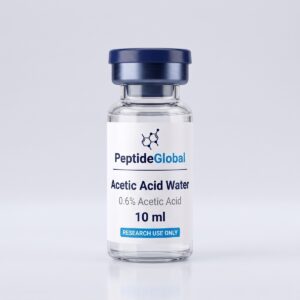
| Supplied here | 3 ml and 10 ml | No | 10 ml |
Bacteriostatic water: the default
Bacteriostatic water is water containing benzyl alcohol at 0.9%, which inhibits the growth of bacteria introduced when a vial is accessed. That is why it is the usual default. Reconstituted peptide solutions are often drawn from more than once, and the preservative reduces the consequences of an imperfect technique on any one of those occasions.
Two limits are worth being precise about. Bacteriostatic means it inhibits growth rather than killing organisms, so it is not sterile and not a substitute for aseptic technique. And it does nothing about chemical degradation: a peptide in bacteriostatic water hydrolyses, deamidates and oxidises at the same rate as in plain water. Both points are covered in bacteriostatic water and peptide stability.
Sterile water: when the preservative is unwanted
Sterile water contains no preservative and is intended for single use. Its advantage is what it leaves out. In some cell-based work a preservative is one more variable that could affect the readout, and some protocols specify a preservative-free diluent for that reason. The trade-off is that once the vial is opened nothing inhibits microbial growth, so the solution is treated as single use or prepared fresh.
Peptide Global does not supply sterile water. Where a protocol calls for it, it should be sourced to whatever grade that protocol specifies.
Acetic acid water: when a peptide will not dissolve
Acetic acid water is water with 0.6% acetic acid. It exists for solubility. As a general principle of peptide chemistry, a peptide's solubility depends on its net charge at the pH of the solvent, and peptides carrying a net positive charge, rich in residues such as lysine and arginine, tend to dissolve more readily in dilute acid than in neutral water.
So acetic acid water is the alternative to reach for when a compound does not dissolve cleanly in bacteriostatic water, or when the compound's own documentation or published methods call for it. It is not a general upgrade. An acidic solution has its own effects on stability and on any assay it is added to, and pH is one of the factors that governs how quickly a peptide degrades in solution. Use it where solubility requires it rather than by default.
3 ml or 10 ml bacteriostatic water
The two sizes hold the same solution. The only difference is volume, and the choice follows from how much reconstitution the work involves.
The 3 ml vial suits reconstituting a single lyophilised vial, or a small number of them, without leaving a large opened volume behind. The 10 ml vial suits several vials or larger volumes, and is the better value per millilitre. A common convention in pharmacy practice treats an opened multi-dose vial as usable for a limited period, often 28 days, after first puncture. Treat that as an upper bound for the diluent rather than as a statement about the stability of any peptide dissolved in it.
How the volume sets the concentration
The volume of diluent added decides the working concentration, and the arithmetic is simple division: mass in the vial divided by volume added.
| Vial | Diluent added | Concentration |
|---|---|---|
| 5 mg | 1 ml | 5 mg/ml |
| 5 mg | 2 ml | 2.5 mg/ml |
| 10 mg | 2 ml | 5 mg/ml |
| 10 mg | 3 ml | 3.33 mg/ml |
| 50 mg | 5 ml | 10 mg/ml |
This is the main practical advantage of a lyophilised vial over a pre-mixed pen: the researcher chooses the concentration rather than accepting a fixed one. It also means measurement error in the diluent volume becomes error in the concentration, which is the trade-off set out in pre-mixed pens versus lyophilised vials.
Technique matters as much as arithmetic. Let a sealed vial reach room temperature before opening, add the diluent slowly down the inside wall of the vial rather than onto the powder, and swirl gently rather than shaking. Agitation creates an air–liquid interface at which peptides can unfold and aggregate. Once reconstituted, the solution is stored cold and protected from light: see how to store research peptides.
Pre-mixed pens need none of this
Every peptide pen in the catalogue arrives with the compound already in solution in a sealed 3 ml cartridge. There is no powder, no diluent to choose and no reconstitution step, so none of the diluents above is needed for them. The diluents are for the lyophilised vials. The full range of pens is laid out in peptide pens compared.
Common questions
What is the difference between bacteriostatic water and sterile water?
Bacteriostatic water contains 0.9% benzyl alcohol, which inhibits bacterial growth when a vial is accessed more than once. Sterile water contains no preservative and is intended for single use. Neither is a substitute for aseptic technique.
Is bac water the same as bacteriostatic water?
Yes. Bac water is the usual shorthand. Peptide water is also used informally, sometimes for bacteriostatic water and sometimes for acetic acid water, so check the composition rather than the name.
When should acetic acid water be used instead of bacteriostatic water?
When a peptide does not dissolve cleanly at neutral pH, or its documentation calls for it. Peptides with a net positive charge tend to dissolve more readily in dilute acid. Otherwise bacteriostatic water is the usual default, because the acid brings its own effects on stability and on assays.
Should I buy 3 ml or 10 ml bacteriostatic water?
It depends on how many vials are being reconstituted. The solution is identical. The 3 ml vial suits one vial or a few without leaving a large opened volume; the 10 ml vial suits several and is cheaper per millilitre.
Does bacteriostatic water make a reconstituted peptide last longer?
Not chemically. It inhibits microbial growth only. Chemical degradation is governed by temperature, light, pH, the peptide's sequence and time, which is why storage conditions matter far more than the choice of diluent.
Do peptide pens need bacteriostatic water?
No. Pens are supplied pre-mixed in a sealed cartridge with no reconstitution step. Diluents are only needed for lyophilised vials.
Products described in this guide
Supplied for laboratory research use only. UK delivery is £4.95, free on orders over £100, tracked as standard.
Continue reading
Research use only
Every compound named on this page is supplied by Peptide Global strictly for laboratory research use only. Nothing here is for human or veterinary use. These are not foods, supplements or cosmetics, and they are not intended to diagnose, treat, cure or prevent any disease. Nothing on this page is medical, veterinary or legal advice, and no part of it describes administration to a person or an animal.
Purchasers are responsible for their own compliance with applicable law and with the requirements of their institution or ethics committee. At checkout, purchasers confirm they are a qualified researcher aged 18 or over and that they accept the Research-Use-Only Policy and Terms & Conditions.