The conditions, and why each one is there
Every product in this catalogue is stored at 2–8 °C, protected from light, and not frozen. Those three conditions are not a house style; each addresses a specific route by which a peptide in solution degrades, and knowing which route matters when a judgement call has to be made.
2–8 °C. Chemical degradation rates rise with temperature. The principal routes for a peptide in aqueous solution — hydrolysis of the peptide bond, deamidation of asparagine and glutamine residues, oxidation of methionine and cysteine — all proceed faster warm than cold. Refrigeration does not stop them; it slows them enough that the useful life of the material is measured in a sensible period rather than in days.
Protect from light. Some residues are photosensitive — tryptophan, tyrosine, phenylalanine, cysteine among them — and light can drive oxidation and other photochemistry directly. For GHK-Cu and the blends containing it this matters more than usual, because a redox-active copper centre participates in that chemistry rather than merely sitting through it.
Do not freeze. This is the condition most often violated on the assumption that colder is always better. It is not, for a solution: see below.
Why freezing a solution is not the safe option
Freezing a peptide already in solution introduces problems that refrigeration does not have. As ice forms, solutes are excluded from the growing crystals and concentrated into the shrinking liquid phase, so the peptide briefly experiences a far higher concentration — and a different pH, since buffer components do not all remain in solution equally — than the nominal formulation. High local concentration promotes aggregation, and aggregation is frequently irreversible.
The ice–water interface itself is a surface, and peptides adsorb to surfaces and can unfold at them. Each freeze–thaw cycle repeats the whole sequence, which is why repeated cycling is worse than a single freeze and why "it was only frozen once" is a meaningful distinction rather than an excuse.
Longer chains are less forgiving of this than short ones, because there is more structure to lose. In this catalogue that points at tesamorelin at forty-four residues plus a modification, more than at a tripeptide.
Note the asymmetry with lyophilised powder, which is where the "colder is better" instinct comes from and where it is often correct. A dry solid has no ice to form and no solute to concentrate, so freezer storage is a normal recommendation for powders. Every product here is supplied pre-mixed, in solution, so that recommendation does not transfer. See pre-mixed pens versus lyophilised vials.
Cold-packing covers transit only
This is the single most consequential point on the page, and the failure it describes happens after delivery rather than before it.
Orders leave cold-packed in thermal-insulated, tamper-evident packaging, in plain outer boxes. That packaging is engineered to hold temperature for the duration of a journey. It is not storage, and it stops working shortly after it arrives.
So a parcel that reaches a building at nine in the morning and is opened at four in the afternoon has spent most of a working day outside its stated conditions, and no amount of cold-packing at the dispatch end changes that. Material should go into refrigerated storage on arrival. In practice that means someone needs to be expecting it — which is a scheduling problem rather than a technical one, and is much the commonest way otherwise sound material is compromised.
The stated conditions apply for as long as the cartridge is held, not merely while it is moving. Dispatch, packing and transit details are on the shipping and delivery page; the conditions themselves are on storage and handling.
What a laboratory fridge does wrong
"Refrigerated" is not a single condition, and a domestic or general-purpose fridge has features worth knowing about.
The door shelves are the warmest part and swing widest with every opening, so they are the worst place for temperature-sensitive material and the most convenient. The rear wall of a fridge with a cooling plate can drop below zero locally, which puts an item pressed against it at risk of the freezing problems described above. Frost-free units work by cycling a heater periodically, so the temperature is less constant than the dial suggests.
None of that argues for special equipment. It argues for putting the material in the body of the fridge rather than the door, keeping it off the back wall, and — if the work justifies it — putting a logging thermometer in with it, since a single reading tells you about one moment and an excursion overnight leaves no trace otherwise.
Handling and inspection
Bring a cartridge to the temperature the work requires deliberately rather than by leaving it out, and return it to storage promptly. Avoid the habit of taking a cartridge out at the start of a session and putting it back at the end; the cumulative time at room temperature adds up faster than it feels like it does.
Avoid vigorous agitation. Shaking generates an air–liquid interface, peptides adsorb to and can unfold at interfaces, and foaming is a visible sign of a process that is not doing the material any good.
Visible change is a crude signal but a real one. Cloudiness or visible particulate matter in a solution that was clear indicates something has altered. For GHK-Cu and the blends containing it, colour is informative in the same way, since the characteristic blue belongs to the intact copper complex. A clear solution is not proof that nothing has happened — most degradation is invisible — but a changed one is proof that something has.
Common questions
How should research peptides be stored?
At 2–8 °C, protected from light, and not frozen. Refrigeration slows the chemical routes by which peptides degrade in solution, light protection addresses photosensitive residues, and freezing a solution introduces aggregation risks that refrigeration does not. The conditions apply for as long as the material is held.
Can I freeze a pre-mixed peptide pen?
No. As ice forms, solutes concentrate into the shrinking liquid phase and the pH shifts, which promotes aggregation — often irreversibly — and the ice–water interface is itself a surface peptides can unfold at. Freezer storage is a reasonable recommendation for lyophilised powder, which has no solution to freeze; it does not transfer to a pre-mixed cartridge.
Does cold-packed delivery mean I do not need to refrigerate it?
No. Cold-packing is engineered to hold temperature for a journey and stops working shortly after arrival. A parcel left unopened through a working day has spent that day outside its stated conditions. Material should go into refrigerated storage on arrival, which means somebody needs to be expecting it.
Where in a fridge should peptides be kept?
In the body of the fridge, not the door — door shelves are the warmest part and swing widest each time it is opened — and not pressed against the rear wall, which can drop below zero locally. A logging thermometer is worth having if the work justifies it, since a single reading says nothing about an overnight excursion.
How can I tell whether a peptide solution has degraded?
Mostly you cannot by eye. Cloudiness, visible particulate matter, or a change in colour where the compound is coloured — as GHK-Cu is — all indicate that something has altered. But a clear solution is not evidence that nothing has, because most degradation is invisible.
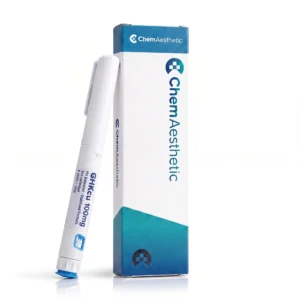
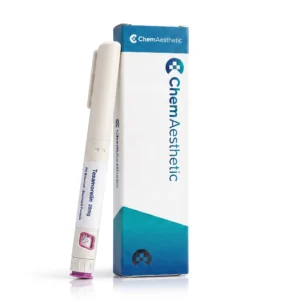
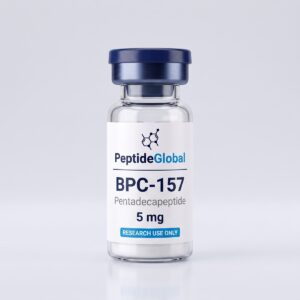
Products described in this guide
Supplied for laboratory research use only. UK delivery is £4.95, free on orders over £100, tracked as standard.
Continue reading
Research use only
Every compound named on this page is supplied by Peptide Global strictly for laboratory research use only. Nothing here is for human or veterinary use. These are not foods, supplements or cosmetics, and they are not intended to diagnose, treat, cure or prevent any disease. Nothing on this page is medical, veterinary or legal advice, and no part of it describes administration to a person or an animal.
Purchasers are responsible for their own compliance with applicable law and with the requirements of their institution or ethics committee. At checkout, purchasers confirm they are a qualified researcher aged 18 or over and that they accept the Research-Use-Only Policy and Terms & Conditions.