Chemical identity
| Component | CAS number | Molecular formula | Molecular weight | Sequence |
|---|---|---|---|---|
| GHK-Cu (copper tripeptide-1) | 89030-95-5 | C14H23CuN6O4+ | 402.92 g/mol | GHK, with Cu(II) coordinated |
| GHK (free tripeptide, for reference) | 49557-75-7 | C14H24N6O4 | 340.38 g/mol | GHK |
| Cartridge strength | 100 mg per cartridge |
|---|---|
| Concentration | 33.33 mg/ml |
| Presentation | Pre-mixed solution, sealed 3 ml cartridge |
| Storage | 2–8 °C, protect from light, do not freeze |
Identifiers verified against PubChem in both directions — name to compound record, then each CAS number back again — and, where the sequence is of standard residues, cross-checked by recomputing the molecular weight from the sequence. No purity, HPLC or certificate-of-analysis figure is stated, because no supplier data supports one.
What GHK-Cu is
GHK is a tripeptide: glycine, histidine and lysine, in that order — three residues, the shortest sequence in this catalogue. GHK-Cu is that tripeptide in complex with a copper(II) ion. In cosmetic ingredient nomenclature the same material is listed as copper tripeptide-1.
The sequence was first identified in human plasma, and the observation that gave it its research career was that the peptide's activity in the systems it was studied in depended on the copper. This is not a peptide to which copper has been added as a stabiliser or a preservative; the metal is coordinated by the peptide — the histidine imidazole is central to that coordination — and the complex is the entity of interest. Separate the two and you no longer have the compound.
That distinction is worth holding onto because it is the main thing people get wrong about GHK-Cu. It is a metallopeptide, and every handling consideration follows from the fact that a coordination complex can dissociate under conditions a plain peptide would tolerate.
Why the copper changes the chemistry
A copper-peptide complex behaves differently from a free peptide in ways that matter at the bench. Copper is redox-active: it cycles between oxidation states, which is the basis of much of the interest in the complex and also a reason the material is sensitive to its environment. Coordination geometry depends on pH, so the complex that exists at one pH is not necessarily the one that exists at another, and competing chelators in a buffer can strip the metal out.
Three practical consequences follow. Buffer choice is not neutral for this compound — a buffer containing a competing ligand can change what is actually present in the well. Any assay involving reactive oxygen species needs care, because a redox-active metal complex participates in that chemistry directly rather than only as the subject of the experiment. And the material's colour, a characteristic blue, is a property of the intact complex, which makes visible change a crude but genuine signal that something has altered.
Storage guidance is therefore stricter in spirit than for a plain short peptide of the same length. Light protection and refrigeration matter, and the stated conditions apply for as long as the cartridge is held. See how to store research peptides.
What is studied in vitro
Skin and connective-tissue cell models dominate the literature. Fibroblast and keratinocyte cultures are used to look at extracellular matrix components — collagen and elastin production, and the balance between matrix metalloproteinases and their inhibitors — with the usual readouts being protein or transcript measurements after treatment across a concentration range.
Wound-model work in culture is a second strand: scratch or migration assays asking how treated cell populations close a gap, and organotypic skin constructs where the question concerns the tissue rather than a single cell type. Antioxidant and redox chemistry is a third, following directly from the copper — assays of the complex's behaviour toward reactive species, and of gene expression changes associated with oxidative stress.
Copper handling itself is studied: whether and how the complex delivers copper into cells, and what distinguishes the peptide complex from an inorganic copper salt at equivalent copper concentration. That last comparison is the control that makes the rest interpretable, and it is the experiment worth looking for in any paper making claims for the complex specifically.
Cosmetic ingredient and research material are not the same thing
GHK-Cu appears in two entirely separate contexts, and conflating them is a real source of confusion. As copper tripeptide-1 it is a cosmetic ingredient, present at low concentration in finished formulations regulated as cosmetics and intended for topical use on people. As a research compound it is supplied on its own, at far higher concentration, outside any such framework.
The molecule can be the same; the products are not, and neither is interchangeable with the other in either direction. The GHK-Cu Pen 100 mg is research material for in-vitro laboratory use only. It is not a cosmetic, not a skincare product and not for use on people. The reasoning is set out in what research use only actually means.
How it is supplied
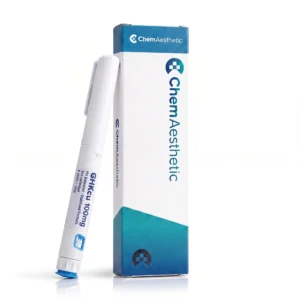
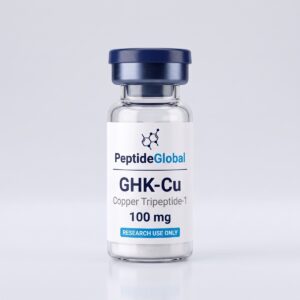
The GHK-Cu Pen 100 mg holds 100 mg pre-mixed in a sealed 3 ml cartridge at 33.33 mg/ml — the most concentrated cartridge in the catalogue, and five times the concentration of the 20 mg pens. Storage is 2–8 °C, protected from light, not frozen.
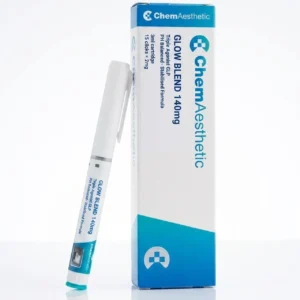
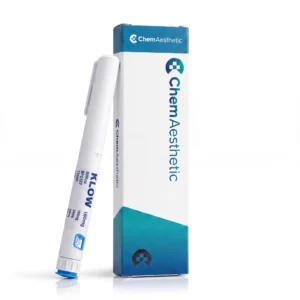
GHK-Cu also appears as a component of two multi-peptide cartridges: the Glow Peptide Pen 140 mg and the KLOW Peptide Pen 160 mg. Both carry 100 mg of GHK-Cu — the same mass as this pen, at the same 33.33 mg/ml — with the other components added on top, and both publish that split. So the GHK-Cu portion is directly comparable across all three cartridges; what is not comparable is a blend's total-peptide cost per milligram against a single compound's. See what is in the Glow blend and blends versus single compounds.
Common questions
What is GHK-Cu?
The tripeptide glycyl-L-histidyl-L-lysine in complex with a copper(II) ion. The sequence was first identified in human plasma, and the copper is coordinated by the peptide rather than added to it — the complex is the compound. In cosmetic nomenclature the same material is copper tripeptide-1.
Is the copper in GHK-Cu an additive?
No. It is coordinated by the peptide, with the histidine residue central to that coordination, and the intact complex is what the research interest concerns. Separating the metal from the peptide gives a different entity, which is why buffer composition and pH matter more for this compound than for a plain short peptide.
Is GHK-Cu the same as the copper peptide in skincare?
It can be the same molecule, but never the same product. As copper tripeptide-1 it appears at low concentration in finished cosmetics regulated as cosmetics and made for topical use on people. Research material is supplied on its own, far more concentrated, outside that framework, and is not interchangeable with it.
Why does GHK-Cu need protecting from light?
Because copper is redox-active and the coordination complex is sensitive to its environment. Light and temperature both bear on that, and the characteristic blue colour is a property of the intact complex — so visible change is a crude but real indication that something has altered.
What strength is the GHK-Cu Pen?
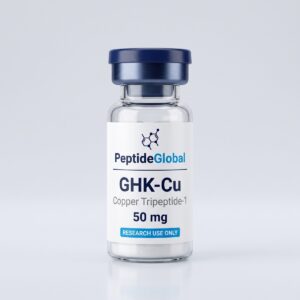
100 mg in a 3 ml cartridge, giving 33.33 mg/ml, the most concentrated cartridge in the catalogue. GHK-Cu also appears as a component of the Glow and KLOW blend pens, where the stated mass is the total across all components.
Is GHK-Cu legal in the UK?
GHK-Cu appears lawfully in two separate regulatory contexts: as the cosmetic ingredient copper tripeptide-1 in finished products regulated as cosmetics, and as a research compound supplied outside that framework for in-vitro laboratory use. The two are not interchangeable, and the material supplied here is the second — not a cosmetic, and not for use on people. Nothing here is legal advice.
Products described in this guide
Supplied for laboratory research use only. UK delivery is £4.95, free on orders over £100, tracked as standard.
Continue reading
Research use only
Every compound named on this page is supplied by Peptide Global strictly for laboratory research use only. Nothing here is for human or veterinary use. These are not foods, supplements or cosmetics, and they are not intended to diagnose, treat, cure or prevent any disease. Nothing on this page is medical, veterinary or legal advice, and no part of it describes administration to a person or an animal.
Purchasers are responsible for their own compliance with applicable law and with the requirements of their institution or ethics committee. At checkout, purchasers confirm they are a qualified researcher aged 18 or over and that they accept the Research-Use-Only Policy and Terms & Conditions.