What a peptide is
A peptide is a chain of amino acids joined end to end by peptide bonds — the bond formed when the carboxyl group of one amino acid condenses with the amino group of the next, releasing water. The sequence of those amino acids, read from one end of the chain to the other, is the peptide's primary structure, and it is what distinguishes one peptide from another. Two peptides built from the same amino acids in a different order are different molecules with different behaviour.
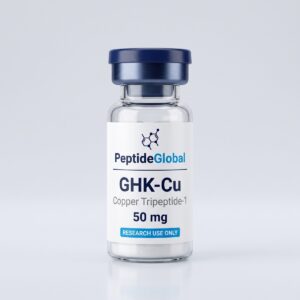
That sequence is not the whole story. A chain long enough to fold adopts a three-dimensional shape, and shape is what determines whether a molecule fits a receptor. Some peptides are cyclic rather than linear, closed into a ring by a bond between two points on the chain, which constrains the shape and changes how readily the molecule is broken down. Others carry modifications that are not amino acids at all: a fatty-acid chain attached to one residue, an acetyl or amide group capping an end, or a metal ion held in a coordination complex, as in GHK-Cu.
The practical consequence is that a peptide's name has to be read precisely. "Tirzepatide" names one specific 39-residue sequence with one specific fatty-acid modification, and nothing else. Colloquial names — "reta", "MT-2", "the glow blend" — name a family or a format rather than a molecule, and what they refer to depends on who is using them.
Peptides and proteins: where the line falls
There is no exact boundary. The convention is that chains of roughly fifty amino acids or fewer are called peptides and longer chains are called proteins, but the number is a convention rather than a rule, and sources place it anywhere from about forty to a hundred residues. What matters more than the count is what the length implies.
Short chains tend to be flexible rather than folded into a stable structure, are usually accessible by chemical synthesis, and are generally cleared quickly by the peptidases present in biological fluids. Longer chains fold into defined structures, are usually produced by expression in a living system rather than assembled chemically, and depend on that fold for their function — which is why they are far more sensitive to heat and to freeze–thaw cycling than a short peptide is.
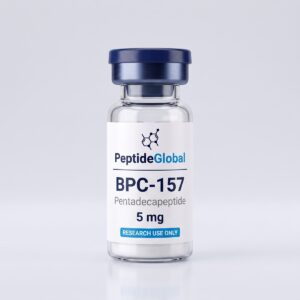
Most of the compounds studied under the heading of research peptides sit at the short end: three residues for GHK-Cu, five for ipamorelin, seven for Semax, fifteen for BPC-157, sixteen for MOTS-c. The incretin analogues are longer — tirzepatide at thirty-nine residues sits close to the conventional line — and behave more like small proteins in handling terms.
How a research peptide is made
Peptides of this length are assembled chemically rather than extracted from tissue. The dominant method is solid-phase peptide synthesis: the chain is built one residue at a time on an insoluble resin bead, with the growing chain anchored at one end so that excess reagents and by-products can be washed away after every step. Each cycle deprotects the chain's reactive end, couples the next amino acid, and washes. When the sequence is complete the chain is cleaved from the resin and purified.
Two features of that process matter to anyone handling the result. First, synthesis is stepwise, so the outcome of each cycle is never quite complete — a synthetic peptide is a principal product accompanied by closely related species such as chains missing a residue, and purification is what separates them. Second, the finished material is normally isolated as a lyophilised — freeze-dried — powder, often as a salt, because a dry solid is far more stable in storage than the same peptide in solution.
Longer chains, and anything that needs a post-translational modification a chemist cannot easily install, are instead produced by recombinant expression in bacterial or yeast culture and then purified from it. That route is normal for proteins and for some longer analogues, and it is a different manufacturing discipline with different failure modes.
Why sequences are studied in vitro
The reason a defined sequence is useful in a laboratory is that receptors discriminate between shapes. A peptide that resembles a receptor's natural ligand closely enough to bind it can be used to ask what happens when that receptor is occupied — whether the peptide activates the receptor like the natural ligand does, blocks it, or activates it partially. Comparing a family of related sequences against the same receptor is how the relationship between structure and activity gets mapped.
Small deliberate changes to a sequence are the main tool. Substituting one residue for another can change how tightly a peptide binds, which of several receptors it prefers, or how quickly enzymes cut it apart. Cyclising a chain or attaching a fatty acid changes how long the molecule persists rather than what it recognises. Much of the published work on the compounds in this catalogue consists of exactly this: a series of sequences, one receptor panel, and the differences between them.
All of that is work done in cell culture, in cell-free preparations and in tissue models. It is not the same thing as clinical investigation, and the compounds supplied on this site are supplied for the former and not the latter.
What “research grade” describes
"Research grade" is not a regulated term and not a specification. No standards body defines it, no authority audits it, and it does not correspond to any pharmacopoeial monograph. It describes an intended use — laboratory research — and the absence of a medicines framework around the material, rather than a measured property of the material itself.
It is worth being explicit about what that absence covers, because the phrase is often read as a quality claim. Research-use-only material has no marketing authorisation. Its manufacture is not subject to regulatory inspection as a medicine, there is no Qualified Person batch release, there is no monograph to assess it against, and there is no pharmacovigilance reporting route. None of that is a criticism of any particular supplier; it is a description of the category, and it applies to every supplier operating in it, this one included.
The corollary is that a specification only tells a purchaser what a supplier has stated. What Peptide Global states about each product is what appears on its product page: the compound, its pharmacological class, the mass in the cartridge, the concentration, the cartridge volume and the storage conditions. Those are the figures the guides in this library quote, and they are the figures worth comparing between suppliers. Anything beyond them should be read as a claim rather than a fact.
How research peptides are supplied
There are two formats in general use. The traditional one is a lyophilised powder in a sealed glass vial, which the researcher reconstitutes with a diluent before use — normally bacteriostatic water. The powder is the more stable of the two states and can be shipped and held for longer, but the concentration of the resulting solution is set by the researcher, so it depends on a measurement made at the bench.
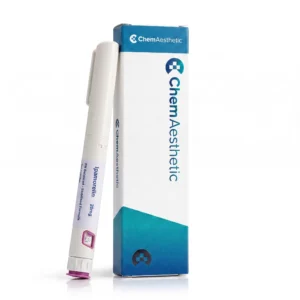
The second format is a pre-mixed cartridge in a dial-dosing pen device. The compound is already in solution at a stated concentration and the cartridge is sealed, so there is no reconstitution step and no transfer between containers. That removes the variability the mixing step introduces, at the cost of a concentration that is fixed at manufacture and cannot be changed. Every product in the Peptide Global catalogue is supplied in this second format, in a 3 ml cartridge; the trade-off between the two formats is set out separately, as is how the pen device works.
Both formats need cold storage. Both should be protected from light. Neither should be frozen once in solution. The storage and handling page carries the conditions that apply across the range, and the storage guide explains why each of them matters.
Common questions
What is the difference between a peptide and a protein?
Length, and what length implies. By convention a chain of roughly fifty amino acids or fewer is a peptide and anything longer is a protein, though the boundary is a convention rather than a defined rule. Shorter chains are usually flexible, chemically synthesised and quickly broken down; longer chains fold into a defined structure they depend on for function, are usually produced biologically, and are more sensitive to heat and freeze–thaw cycling.
Are research peptides the same as the peptides in cosmetics?
Sometimes the same molecule, never the same product. GHK-Cu, for example, appears both as a cosmetic ingredient at low concentration in a finished formulation and as a research compound supplied on its own. A cosmetic product is regulated as a cosmetic and formulated for topical use on people; research material is neither. The two are not interchangeable in either direction.
Does “research grade” mean high purity?
No. It is not a graded scale and not a regulated term — it describes intended use rather than a measured property, and no standards body defines it. Compare the specifications a supplier actually states, which for the products on this site are the compound, class, cartridge mass, concentration, volume and storage conditions.
Why are peptides supplied as a powder rather than a solution?
Because a dry solid is more stable than the same peptide dissolved in water. Once in solution a peptide is exposed to hydrolysis and to whatever else the solution allows, so shelf life shortens considerably. Pre-mixed formats accept that shorter window in exchange for removing the reconstitution step; lyophilised formats keep the longer window and put the mixing step on the researcher.
Can research peptides be used on people or animals?
No. Everything supplied by Peptide Global is for in-vitro laboratory research only. It is not for human or veterinary use, not for any diagnostic or therapeutic purpose, and not a food, supplement or cosmetic. That basis applies to every order and cannot be varied by agreement.
Products described in this guide
Supplied for laboratory research use only. UK delivery is £4.95, free on orders over £100, tracked as standard.

Continue reading
Research use only
Every compound named on this page is supplied by Peptide Global strictly for laboratory research use only. Nothing here is for human or veterinary use. These are not foods, supplements or cosmetics, and they are not intended to diagnose, treat, cure or prevent any disease. Nothing on this page is medical, veterinary or legal advice, and no part of it describes administration to a person or an animal.
Purchasers are responsible for their own compliance with applicable law and with the requirements of their institution or ethics committee. At checkout, purchasers confirm they are a qualified researcher aged 18 or over and that they accept the Research-Use-Only Policy and Terms & Conditions.