Chemical identity
| Designation | MOTS-c |
|---|---|
| CAS number | 1627580-64-6 |
| Molecular formula | C101H152N28O22S2 |
| Molecular weight | 2174.6 g/mol |
| Amino-acid sequence | MRWQEMGYIFYPRKLR |
| Cartridge strength | 60 mg per cartridge |
| Concentration | 20 mg/ml |
| Presentation | Pre-mixed solution, sealed 3 ml cartridge |
| Storage | 2–8 °C, protect from light, do not freeze |
Identifiers verified against PubChem in both directions — name to compound record, then each CAS number back again — and, where the sequence is of standard residues, cross-checked by recomputing the molecular weight from the sequence. No purity, HPLC or certificate-of-analysis figure is stated, because no supplier data supports one.
What MOTS-c is
MOTS-c is a peptide of sixteen amino acids whose coding sequence sits not in the cell nucleus but inside mitochondrial DNA — specifically within the region encoding the 12S ribosomal RNA. The name is an acronym: mitochondrial open reading frame of the twelve S rRNA type-c.
That origin is what makes it notable. Mitochondria carry their own small circular genome, a remnant of the organelle's bacterial ancestry, and it was long taken to encode only a handful of components of the respiratory chain plus the RNAs needed to make them. MOTS-c belongs to a small group of peptides identified as being encoded within that genome in reading frames overlapping the RNA genes — short open reading frames that conventional annotation had passed over.
It is an endogenous human peptide rather than a designed molecule, so the synthetic material is a copy of a natural sequence rather than an engineered analogue. It holds no marketing authorisation anywhere and is supplied here as research material only.
Why the origin matters
A peptide encoded in mitochondrial DNA raises a structural question about how a cell is organised. The conventional picture has the nucleus issuing instructions and the mitochondria responding — mitochondrial biogenesis and function largely directed by nuclear genes. A peptide encoded in the mitochondrial genome that acts outside the mitochondrion inverts part of that: signalling running from the organelle outward.
That framing, usually described as retrograde or mitochondrial-to-nuclear signalling, is the context most published work on MOTS-c sits in. The questions are about whether and how a mitochondrially encoded peptide reaches targets elsewhere in the cell, what those targets are, and what the signal reports.
It is worth being straight that this is an active research area rather than settled ground. The peptide's identification is relatively recent by the standards of the other compounds in this catalogue, the literature is smaller, and mechanistic accounts should be read as proposals under investigation rather than established description. That is a reason to work on it, not a caveat about the compound.
What is studied in vitro
Metabolic signalling in cell culture is the dominant strand. The AMP-activated protein kinase pathway — a central sensor of cellular energy state — recurs throughout the literature, and the usual readouts are phosphorylation states of pathway components measured by immunoblot after treating cells with the peptide across a concentration range and a time course.
Because MOTS-c has been reported in the nucleus of treated cells, subcellular localisation work is a second strand: fluorescent labelling or fractionation to establish where the peptide ends up, and under what conditions. Related experiments look at transcriptional responses in treated cells, which is the question localisation naturally leads to.
Metabolic phenotyping of cultured cells — respirometry, glucose handling in myotube or hepatocyte models — is used where the question is functional rather than mechanistic. Stability and handling work matters here as elsewhere, since a 16-residue peptide in solution is subject to the usual degradation routes.
How it is supplied
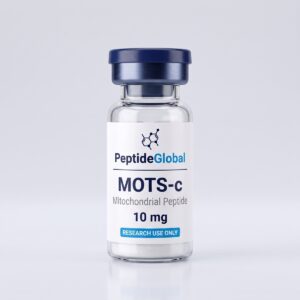
Peptide Global supplies it as the MOTS-c Peptide Pen 60 mg: 60 mg pre-mixed in a sealed 3 ml cartridge at 20 mg/ml, in a dial-dosing pen device, with no reconstitution step.
At 60 mg this is one of the larger single-compound fills in the catalogue, at 20 mg/ml. For work where the quantity of material rather than the concentration is the limiting factor, that is the relevant figure; the arithmetic of mass, volume and increments is set out in how the pen works.
Storage is 2–8 °C, protected from light and not frozen, for as long as the cartridge is held. See storage and handling.
Common questions
What is MOTS-c?
A 16-amino-acid peptide encoded within mitochondrial DNA, in a short open reading frame inside the region coding for the 12S ribosomal RNA. It is an endogenous human peptide rather than an engineered analogue, and it belongs to a small group of peptides identified as being encoded in the mitochondrial genome.
Why is MOTS-c called a mitochondrial-derived peptide?
Because its coding sequence sits in the mitochondrial genome rather than the nuclear one. That is unusual: mitochondrial DNA was long taken to encode only respiratory-chain components and the RNAs needed to make them, and MOTS-c sits in a reading frame overlapping one of those RNA genes.
What pathway is MOTS-c studied in relation to?
Most published in-vitro work concerns metabolic signalling, with the AMP-activated protein kinase pathway recurring throughout, alongside subcellular localisation work asking where the peptide ends up in treated cells. The field is relatively young and mechanistic accounts are best read as proposals under investigation.
Is MOTS-c a natural or a synthetic peptide?
The sequence is natural — an endogenous human peptide. The material supplied is synthesised chemically, so it is a synthetic copy of a natural sequence rather than a designed analogue of one.
What strength is the MOTS-c Pen?
60 mg in a 3 ml cartridge, giving 20 mg/ml — one of the two largest single-compound fills in the catalogue.
Is MOTS-c legal in the UK?
MOTS-c holds no UK marketing authorisation and no licensed medicine contains it. It is an endogenous human peptide supplied here as a research compound, and material supplied for in-vitro laboratory research sits outside the medicines framework rather than being prohibited by it. Institutional policy is frequently the stricter test. Nothing here is legal advice.
Products described in this guide
Supplied for laboratory research use only. UK delivery is £4.95, free on orders over £100, tracked as standard.

Continue reading
Research use only
Every compound named on this page is supplied by Peptide Global strictly for laboratory research use only. Nothing here is for human or veterinary use. These are not foods, supplements or cosmetics, and they are not intended to diagnose, treat, cure or prevent any disease. Nothing on this page is medical, veterinary or legal advice, and no part of it describes administration to a person or an animal.
Purchasers are responsible for their own compliance with applicable law and with the requirements of their institution or ethics committee. At checkout, purchasers confirm they are a qualified researcher aged 18 or over and that they accept the Research-Use-Only Policy and Terms & Conditions.