What the device is
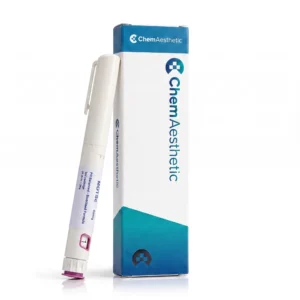
A pre-mixed peptide pen is two things: a sealed cartridge holding the compound already in solution, and a dial mechanism that dispenses a measured volume from it. There is no powder, no diluent and no reconstitution step — the cartridge is filled and sealed at manufacture.
Every pen in the Peptide Global catalogue uses a 3 ml cartridge. What differs between products is the mass of peptide dissolved in that 3 ml, and therefore the concentration: from 6.67 mg/ml in the 20 mg pens to 53.33 mg/ml of total peptide in the KLOW blend. Same container, eightfold range of contents.
The dial meters volume, not mass
This is the whole of what there is to understand about the format, and getting it the wrong way round is the source of nearly every arithmetic mistake made with these devices.
The mechanism advances the plunger by a fixed distance per increment, which displaces a fixed volume of solution. It has no way of knowing what is dissolved in that volume. So the mass delivered per increment is not a property of the device — it is the product of the device's volume step and the concentration of the cartridge fitted to it.
The consequence is that a click means different things on different pens. A stated graduation belongs to one cartridge fill and does not transfer. Two pens that look identical, feel identical and click identically will deliver masses differing by a factor of ten if their concentrations differ by a factor of ten.
The arithmetic, worked through
The MOTS-c pen page states the graduation for that cartridge: 25 clicks corresponds to 5 mg, on a pen holding 60 mg in 3 ml — a concentration of 20 mg/ml.
From those figures the volume step follows. 5 mg at 20 mg/ml occupies 0.25 ml, and 0.25 ml over 25 clicks is 0.01 ml per click. A 3 ml cartridge therefore holds 300 increments nominally, whatever it contains.
Applying that step to each concentration in the catalogue gives the mass per increment:
| Concentration | Mass per click | Pens at this concentration |
|---|---|---|
| 6.67 mg/ml | 0.067 mg | Ipamorelin, Tesamorelin, Semax, Selank, MT2 — all 20 mg |
| 13.33 mg/ml | 0.133 mg | BPC-157 + TB-500 40 mg |
| 20 mg/ml | 0.2 mg | MOTS-c 60 mg |
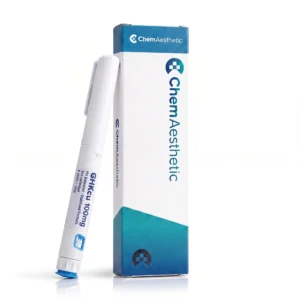
| 33.33 mg/ml | 0.333 mg | GHK-Cu 100 mg |
| 46.67 mg/ml | 0.467 mg | Glow blend 140 mg (total peptide) |
| 53.33 mg/ml | 0.533 mg | KLOW blend 160 mg (total peptide) |
This table is arithmetic derived from each product's stated concentration and the 0.01 ml step implied by the MOTS-c graduation. It is not a manufacturer specification for every device. The graduation printed on or stated for the pen in hand governs — check it rather than relying on a figure calculated elsewhere, and treat the increment count as nominal, because a small residual volume stays in the cartridge and device and is not deliverable.
Blends: the mass is a total, not a component
For the Glow and KLOW cartridges, and the BPC-157 + TB-500 pen, the concentration in the table above is total peptide. The split is published on each product page, so the per-click figure resolves into components rather than staying a total.
Every blend in the range is filled at the same per-component concentrations as the single-compound pens — GHK-Cu at 33.33 mg/ml, and BPC-157, TB-500 and KPV at 6.67 mg/ml each. At 0.01 ml per click that is 0.333 mg of GHK-Cu and 0.067 mg of each other component, whichever blend it is. The KLOW product page states six clicks as GHK-Cu 2 mg with 0.4 mg of each of the other three, which is exactly that arithmetic — a useful independent check on the 0.01 ml increment derived above. What a blend fixes is the ratio between components, not the information about them: see blends versus single compounds.
What the format removes, and what it fixes in place
Because the cartridge arrives filled and sealed, several operations disappear: measuring a diluent volume, dissolving a powder, transferring between containers, and repeatedly accessing a shared vial. Each of those is a step that can go wrong and a source of variation between one preparation and the next, so removing them removes that variation — which is the format's genuine advantage.
What it removes in exchange is control over concentration. A researcher reconstituting a lyophilised powder chooses the concentration; with a pre-mixed cartridge the concentration is a property of the product. Where the required working concentration differs from what the cartridge provides, the dispensed volume has to be diluted downstream, and at that point the format's advantage is partly given back. The trade-off in full is in pre-mixed pens versus lyophilised vials.
Storage is unaffected by the format: a sealed cartridge is a peptide in solution, held at 2–8 °C, protected from light and not frozen, for as long as it is kept. See how to store research peptides.
Common questions
How does a pre-mixed peptide pen work?
A sealed 3 ml cartridge holds the compound already in solution, and a dial mechanism advances a plunger by a fixed distance per increment, displacing a fixed volume. There is no powder, no diluent and no reconstitution step.
Does one click deliver the same amount on every pen?
The same volume, not the same mass. The device meters volume and has no way of knowing what is dissolved in it, so mass per click is the volume step multiplied by that cartridge's concentration. Two identical-feeling pens with concentrations differing tenfold deliver masses differing tenfold.
How many clicks is 5 mg on a MOTS-c pen?
Twenty-five, on the 60 mg cartridge — a property of that concentration, 20 mg/ml, rather than of the device. It does not transfer to a pen filled differently. Check the graduation stated for the pen in hand.
How many increments does a 3 ml cartridge hold?
Three hundred nominally, at the 0.01 ml step implied by the MOTS-c graduation. Nominally, because a small residual volume stays in the cartridge and device and is not deliverable, so the count actually available is lower.
Can I work out the mass of one component from a blend pen?
Yes, because the split is published. Every blend is filled at 33.33 mg/ml GHK-Cu and 6.67 mg/ml of each other component, so one 0.01 ml click delivers 0.333 mg of GHK-Cu and 0.067 mg of each of the others. The KLOW page's own figure — six clicks to GHK-Cu 2 mg and 0.4 mg each — matches exactly.
Products described in this guide
Supplied for laboratory research use only. UK delivery is £4.95, free on orders over £100, tracked as standard.
Continue reading
Research use only
Every compound named on this page is supplied by Peptide Global strictly for laboratory research use only. Nothing here is for human or veterinary use. These are not foods, supplements or cosmetics, and they are not intended to diagnose, treat, cure or prevent any disease. Nothing on this page is medical, veterinary or legal advice, and no part of it describes administration to a person or an animal.
Purchasers are responsible for their own compliance with applicable law and with the requirements of their institution or ethics committee. At checkout, purchasers confirm they are a qualified researcher aged 18 or over and that they accept the Research-Use-Only Policy and Terms & Conditions.