What bacteriostatic water is
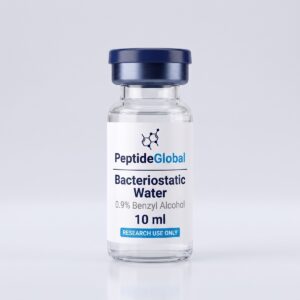
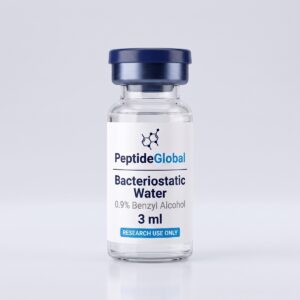
Bacteriostatic water is water containing an added agent that inhibits bacterial growth. The agent in general use is benzyl alcohol, conventionally at around 0.9 per cent. It is the standard diluent for reconstituting a lyophilised peptide, which arrives as a freeze-dried solid and has to be dissolved before it can be used.
The word bacteriostatic is doing precise work and is worth taking literally. A bacteriostatic agent inhibits growth; a bactericidal one kills. Benzyl alcohol at that concentration suppresses the multiplication of organisms introduced during handling — the practical scenario being that a vial gets accessed more than once — rather than sterilising anything. Bacteriostatic water is not sterile water and is not a substitute for aseptic technique; it reduces the consequences of an imperfect one.
It is distinct from both sterile water for injection, which contains no preservative and is intended for single use, and from plain laboratory-grade water. Which is appropriate depends on the work, and the choice is a real one rather than a formality.
What it does not do
This is the misconception worth correcting, because it is widespread and it leads to material being trusted longer than it should be. Bacteriostatic water addresses microbial growth. It does nothing about chemical degradation.
The routes by which a peptide in solution loses integrity are chemical: hydrolysis of the peptide bond, deamidation of asparagine and glutamine residues, oxidation of methionine and cysteine, and aggregation. Benzyl alcohol has no effect on any of them. A peptide reconstituted in bacteriostatic water degrades chemically at the same rate as the same peptide in plain water under the same conditions.
So "reconstituted in bacteriostatic water" is not a statement about stability, and the presence of a preservative is not a reason to extend how long a solution is treated as usable. What governs chemical stability is temperature, light exposure, pH, the peptide's own sequence, and time. The diluent's contribution to that list is small; the storage conditions dominate, which is why they get their own guide in how to store research peptides.
What actually governs stability in solution
Four things, in roughly descending order of how much difference they make.
Temperature. Every chemical degradation route runs faster warm. This is the largest single lever available and the reason refrigeration is not optional.
The sequence itself. Stability is not a general property of peptides; it depends on which residues are present. A sequence containing methionine or cysteine has oxidation-sensitive positions. Asparagine and glutamine are the residues that deamidate, and how fast depends on what sits next to them. Aspartate-glycine and asparagine-glycine pairs are known weak points. Two peptides of identical length can have quite different useful lives for this reason, so a general rule of thumb about "peptides in solution" is a poor guide to any specific one.
pH. Both hydrolysis and deamidation are pH-dependent, and every peptide has a pH range in which it is most stable. A diluent that shifts the pH away from that range shortens the material's life regardless of what else it contains — which is one genuine way the choice of diluent bears on stability, though not through its preservative.
Interfaces and agitation. Peptides adsorb to surfaces and can unfold at them, and an air–liquid interface generated by shaking is a surface. Visible foaming is a sign of a process worth avoiding.
Why this matters less for a pre-mixed cartridge
Every product Peptide Global supplies is pre-mixed: the compound is already in solution in a sealed cartridge at a stated concentration. There is no lyophilised powder, no diluent to choose, no reconstitution step and no bacteriostatic water involved at any point.
That removes a set of failure modes rather than merely relocating them. There is no measurement error in the diluent volume, no chance of a diluent that shifts the pH unfavourably, no transfer between containers and no repeated access to a shared vial — and consequently much less for a bacteriostatic agent to be needed for. What replaces those is a concentration fixed at manufacture that cannot be adjusted, which is a real constraint and is the honest cost of the format. Both sides are set out in pre-mixed pens versus lyophilised vials.
What the format does not remove is any of the chemistry described above. A sealed pre-mixed cartridge is a peptide in solution, subject to the same temperature, light, pH and time dependence as any other solution. That is why the storage conditions for these products are the conditions for a solution — 2–8 °C, protected from light, not frozen — rather than the freezer storage often recommended for a powder.
Common questions
What is bacteriostatic water?
Water containing an added agent, conventionally benzyl alcohol at about 0.9 per cent, that inhibits bacterial growth. It is the standard diluent for reconstituting lyophilised peptides. Bacteriostatic means it inhibits multiplication rather than killing organisms, so it is not sterile water and not a substitute for aseptic technique.
Does bacteriostatic water make a peptide last longer?
Not chemically. It addresses microbial growth only, and has no effect on hydrolysis, deamidation, oxidation or aggregation — the routes by which a peptide in solution actually loses integrity. A peptide in bacteriostatic water degrades chemically at the same rate as the same peptide in plain water under the same conditions.
What does govern how long a peptide solution lasts?
Temperature above all, then the sequence itself — methionine and cysteine are oxidation-sensitive, asparagine and glutamine deamidate — then pH, then agitation and surface exposure. Two peptides of the same length can have quite different useful lives depending on which residues they contain.
Do the Peptide Global pens need bacteriostatic water?
No. Every product is supplied pre-mixed in a sealed cartridge at a stated concentration, so there is no powder to reconstitute, no diluent to choose and no reconstitution step. The trade-off is a concentration fixed at manufacture that cannot be adjusted.
Is bacteriostatic water the same as sterile water for injection?
No. Sterile water for injection contains no preservative and is intended for single use; bacteriostatic water contains one, which is what makes repeated access to a vial less consequential. Neither is plain laboratory-grade water, and which is appropriate depends on the work.
Products described in this guide
Supplied for laboratory research use only. UK delivery is £4.95, free on orders over £100, tracked as standard.
Continue reading
Research use only
Every compound named on this page is supplied by Peptide Global strictly for laboratory research use only. Nothing here is for human or veterinary use. These are not foods, supplements or cosmetics, and they are not intended to diagnose, treat, cure or prevent any disease. Nothing on this page is medical, veterinary or legal advice, and no part of it describes administration to a person or an animal.
Purchasers are responsible for their own compliance with applicable law and with the requirements of their institution or ethics committee. At checkout, purchasers confirm they are a qualified researcher aged 18 or over and that they accept the Research-Use-Only Policy and Terms & Conditions.