Chemical identity
| Component | CAS number | Molecular formula | Molecular weight | Sequence |
|---|---|---|---|---|
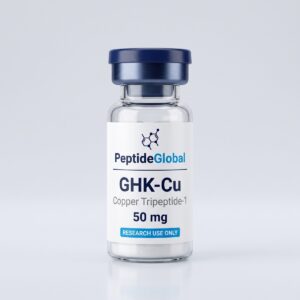
| GHK-Cu | 89030-95-5 | C14H23CuN6O4+ | 402.92 g/mol | GHK + Cu(II) |
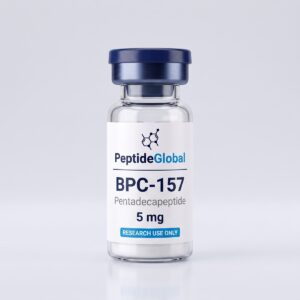
| BPC-157 | 137525-51-0 | C62H98N16O22 | 1419.5 g/mol | GEPPPGKPADDAGLV |
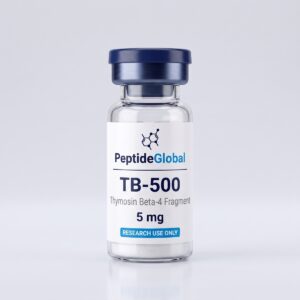
| TB-500 | 885340-08-9 | C38H68N10O14 | 889.0 g/mol | Ac-LKKTETQ |
| Cartridge strength | 140 mg total peptide per cartridge |
|---|---|
| Concentration | 46.67 mg/ml total peptide |
| Presentation | Pre-mixed solution, sealed 3 ml cartridge |
| Storage | 2–8 °C, protect from light, do not freeze |
A blend has no single CAS number, formula or molecular weight — it is three distinct molecules in one solution, so each is listed separately. The 140 mg total is GHK-Cu 100 mg, BPC-157 20 mg and TB-500 20 mg, which is 33.33 mg/ml GHK-Cu and 6.67 mg/ml of each of the other two. Those are the same per-component concentrations as the corresponding single-compound pens, so a known concentration of any one component is a published figure.
Identifiers verified against PubChem in both directions — name to compound record, then each CAS number back again — and, where the sequence is of standard residues, cross-checked by recomputing the molecular weight from the sequence. No purity, HPLC or certificate-of-analysis figure is stated, because no supplier data supports one.
What the Glow blend is
"Glow" is a trade name for a combination, not a compound. The Glow blend is three peptides supplied together in one pre-mixed cartridge: GHK-Cu, BPC-157 and TB-500. There is no molecule called Glow, and the name carries no specification — what it means depends entirely on who is using it.
That is worth stating first because blend names in this market are not standardised. Another supplier's "glow" may contain a different set of components, or the same components in a different ratio, and neither would be wrong — there is no definition to be wrong about. The components and the total mass are the specification; the name is a label on top of it.
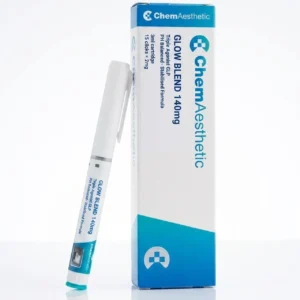
Peptide Global's Glow Peptide Pen 140 mg holds 140 mg of total peptide across those three components in a sealed 3 ml cartridge — 46.67 mg/ml of total peptide, the second most concentrated cartridge in the catalogue after the GHK-Cu pen.
The three components
The components come from unrelated origins, which is the first thing to understand about the combination: this is not three variants of one thing.
- GHK-Cu — the tripeptide glycyl-L-histidyl-L-lysine holding a copper(II) ion in a coordination complex. A metallopeptide, first identified in human plasma, studied largely in skin and connective-tissue cell models. The copper is part of the molecule rather than an additive, which makes this component the one most sensitive to its chemical environment.
- BPC-157 — a 15-residue synthetic peptide corresponding to a partial sequence of a protein described in gastric juice. It has no consensus molecular target; mechanistic accounts describe pathways it has been reported to influence rather than a binding site.
- TB-500 — a synthetic fragment of thymosin β4, generally the short actin-binding region. Unlike the other two it has a defined, directly measurable biochemical activity in actin binding.
What links them is not mechanism but the fact that all three have been studied in the context of tissue repair and cell migration. They arrive at that context by different routes, and two of the three lack a defined receptor.
What the published split lets you do
The 140 mg is GHK-Cu 100 mg, BPC-157 20 mg and TB-500 20 mg, and that split is stated on the product page. In a 3 ml cartridge that works out at 33.33 mg/ml of GHK-Cu and 6.67 mg/ml of each of the other two — the same per-component concentrations as the corresponding single-compound pens. That is how the blend is built, and it is why the arithmetic comes out in round numbers.
So a per-component concentration is a published figure here rather than an unknown. At the 0.01 ml dial increment, one click delivers 0.333 mg of GHK-Cu and 0.067 mg of each of the other two. An experiment needing a known concentration of one component can have it, and the figure is checkable against the specification instead of assumed.
What the format fixes is the ratio, not the information. GHK-Cu sits at 100 parts against 20 and 20, set at manufacture and not variable: dispensing more to raise the BPC-157 concentration raises the GHK-Cu concentration five times as fast. A design that needs the three at independently chosen concentrations needs them supplied separately, and the GHK-Cu Pen 100 mg is the only one of the three sold on its own here.
The one thing a blend genuinely cannot do is attribute an observation to a single component within a single experiment — three peptides were present, so the result belongs to the mixture. That is a limit of experimental design rather than of the specification, and the answer to it is running the components separately as controls. The full argument is in blends versus single compounds.
Handling a three-component cartridge
A blend inherits the strictest handling requirement of any of its components rather than an average of them. Here that is set by GHK-Cu: a copper coordination complex is sensitive to pH and to competing chelators, and copper is redox-active. Light protection and refrigeration therefore matter for the cartridge as a whole, not only for the GHK-Cu content of it.
The stated conditions are 2–8 °C, protected from light, not frozen, and they apply for as long as the cartridge is held rather than only during transit. Orders leave cold-packed in plain outer packaging; cold-packing covers the journey, so the cartridge should go into refrigerated storage on arrival. See how to store research peptides and storage and handling.
One further point specific to blends: because three peptides share one solution, any assessment of the cartridge's condition is an assessment of the mixture. There is no way to establish that two components are unaffected and one is not.
Common questions
What is in the Glow blend?
Three peptides in one pre-mixed cartridge: GHK-Cu, BPC-157 and TB-500. Peptide Global's Glow Peptide Pen holds 140 mg of total peptide across those components in a sealed 3 ml cartridge, at 46.67 mg/ml of total peptide.
Is “Glow” a compound?
No. It is a trade name for a combination, and blend names in this market are not standardised — another supplier's "glow" may hold different components or a different ratio, and neither would be wrong because there is no definition to be wrong about. The component list and total mass are the specification.
How much of each peptide is in the Glow pen?
GHK-Cu 100 mg, BPC-157 20 mg and TB-500 20 mg, giving 140 mg in total. In the 3 ml cartridge that is 33.33 mg/ml of GHK-Cu and 6.67 mg/ml of each of the other two — the same per-component concentrations as the single-compound pens. The ratio is fixed at manufacture, but it is published, so a per-component concentration is a stated figure.
What is the difference between the Glow and KLOW pens?
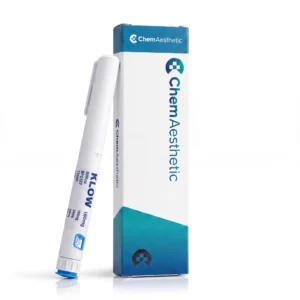
KLOW adds a fourth component, the tripeptide KPV, to the same three, and holds 160 mg of total peptide rather than 140 mg. Both are 3 ml cartridges.
Can I compare the Glow pen with the GHK-Cu pen on price per milligram?
Only with care. Both hold GHK-Cu at 33.33 mg/ml, and the Glow cartridge contains the same 100 mg the standalone pen does, so the GHK-Cu portions are directly comparable. What does not compare is total peptide against a single compound: the Glow pen adds 40 mg of two costlier peptides, so a lower headline cost per milligram reflects what is in the mixture rather than better value.
Is the Glow peptide blend legal in the UK?
None of the three components holds a UK marketing authorisation, and no licensed UK medicine contains any of them. The blend is supplied for in-vitro laboratory research, which sits outside the medicines framework rather than being prohibited by it. BPC-157 and TB-500 are also on the World Anti-Doping Agency's prohibited list, which may bear on institutional rules. Nothing here is legal advice.
Products described in this guide
Supplied for laboratory research use only. UK delivery is £4.95, free on orders over £100, tracked as standard.
Continue reading
Research use only
Every compound named on this page is supplied by Peptide Global strictly for laboratory research use only. Nothing here is for human or veterinary use. These are not foods, supplements or cosmetics, and they are not intended to diagnose, treat, cure or prevent any disease. Nothing on this page is medical, veterinary or legal advice, and no part of it describes administration to a person or an animal.
Purchasers are responsible for their own compliance with applicable law and with the requirements of their institution or ethics committee. At checkout, purchasers confirm they are a qualified researcher aged 18 or over and that they accept the Research-Use-Only Policy and Terms & Conditions.