Chemical identity
| Component | CAS number | Molecular formula | Molecular weight | Sequence |
|---|---|---|---|---|
| TB-500 (acetylated Tβ4 fragment) | 885340-08-9 | C38H68N10O14 | 889.0 g/mol | Ac-LKKTETQ |
| Thymosin β4, full length (for reference) | (none listed in PubChem) | C212H350N56O78S | 4963 g/mol | 43 amino acids — a different molecule, see below |
| Cartridge strength | 40 mg total peptide per cartridge (with BPC-157) |
|---|---|
| Concentration | 13.33 mg/ml total peptide |
| Presentation | Pre-mixed solution, sealed 3 ml cartridge |
| Storage | 2–8 °C, protect from light, do not freeze |
Both rows are given because "TB-500" is used for both molecules. The identity that matches the acetylated seven-residue actin-binding fragment is the first row; the full 43-residue protein is five and a half times its mass. Confirm which a supplier means before comparing anything. The cartridge holds 40 mg total as 20 mg TB-500 and 20 mg BPC-157 — 6.67 mg/ml of each.
Identifiers verified against PubChem in both directions — name to compound record, then each CAS number back again — and, where the sequence is of standard residues, cross-checked by recomputing the molecular weight from the sequence. No purity, HPLC or certificate-of-analysis figure is stated, because no supplier data supports one.
What TB-500 is
TB-500 is a synthetic peptide derived from thymosin β4, an actin-binding protein of forty-three amino acids found widely in mammalian cells. Thymosin β4 is not a hormone; its principal characterised function is binding monomeric actin, and through that binding it participates in the regulation of the cytoskeleton — the filament network that determines cell shape and drives cell movement.
The portion of thymosin β4 responsible for actin binding has been localised to a short internal region, and TB-500 as generally supplied corresponds to that region rather than to the whole protein. The relevant motif is usually given as the sequence around residues 17 to 23.
Neither thymosin β4 nor TB-500 holds a UK marketing authorisation. Both thymosin β4 and its fragments fall under the World Anti-Doping Agency's prohibited list, prohibited at all times rather than only in competition — the same position as BPC-157, and included here for the same reason: it may bear on an institution's own rules.
The name is genuinely ambiguous
"TB-500" does not unambiguously identify a sequence, and this is the most useful thing to know about it. The designation is a supplier-side label rather than a formal chemical name, and it is used inconsistently.
Most commonly it refers to the short actin-binding fragment described above, frequently with an acetylated amino terminus. It is also, less often, used loosely for full-length thymosin β4 — a forty-three-residue protein, which is a materially different molecule with different handling behaviour and a different mass. Some listings use "TB-500" and "thymosin β4" interchangeably, which conflates the two.
The practical rule is to compare the stated sequence or the stated mass rather than the name. Two listings both reading "TB-500" may not be the same compound, and no amount of comparing prices resolves that. This is the clearest single example of the general point made in what to check before ordering: in this market the specification carries the information and the name frequently does not.
Actin binding as a mechanistic handle
What distinguishes TB-500 from BPC-157, with which it is almost always paired, is that it has a defined biochemical activity to work from. Actin binding is measurable: the interaction between the peptide and monomeric actin can be assayed directly, the effect on the balance between monomeric and filamentous actin can be quantified, and the contribution of individual residues in the motif can be tested by substitution.
That does not mean everything about the compound is settled — how a defined actin-binding activity relates to the tissue-level observations reported for the parent protein is a long way from resolved. But it does mean an experiment has something concrete to measure and attribute results to, which is not the case for a compound with no consensus target. It is the main reason the two compounds, despite being studied for overlapping reasons, present quite different experimental problems. The comparison guide develops this.
What is studied in vitro
Actin biochemistry is the primary strand: binding assays against purified monomeric actin, polymerisation assays tracking filament formation over time in the presence and absence of the peptide, and structural work on the peptide-actin interaction. These are cell-free experiments and they are the most directly interpretable work on the compound.
Cell-based work follows from the cytoskeletal role. Migration and wound-closure assays predominate, since cell movement depends on actin dynamics, and imaging of the actin cytoskeleton in treated cells addresses the mechanism directly rather than by inference. Endothelial assays — tube formation, sprouting — appear where the question concerns vasculature.
Comparative work between the fragment and full-length thymosin β4 is a distinct and useful strand, because it addresses precisely the ambiguity described above: whether, and in which assays, the short motif reproduces what the whole protein does.
How it is supplied
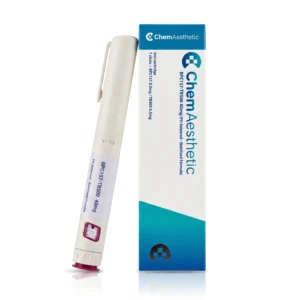
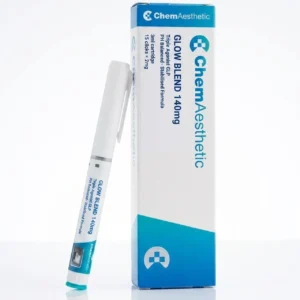
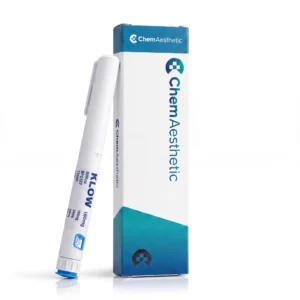
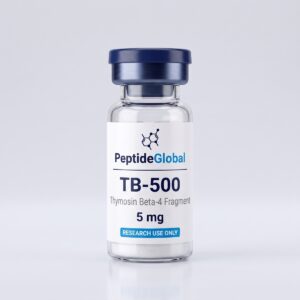
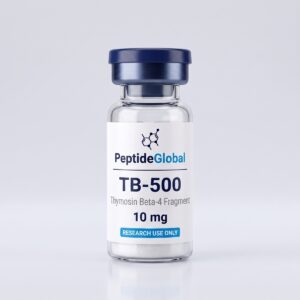
Peptide Global does not supply TB-500 on its own. It appears as a component of three multi-peptide cartridges: the BPC-157 + TB-500 Pen 40 mg at 40 mg total in 3 ml, the Glow Peptide Pen 140 mg alongside GHK-Cu and BPC-157, and the KLOW Peptide Pen 160 mg which adds KPV to those three.
Each of those cartridges publishes its split, and TB-500 is present at 20 mg — 6.67 mg/ml — in all three. That matters more for this compound than for most: TB-500's defining experimental advantage is that actin binding can be measured against a known concentration, and a published split means the blend formats preserve that rather than removing it. One 0.01 ml click delivers 0.067 mg. What is fixed is the ratio to the other components. See blends versus single compounds.
Storage is 2–8 °C, protected from light, not frozen. See storage and handling.
Common questions
What is TB-500?
A synthetic peptide derived from thymosin β4, a 43-residue actin-binding protein found widely in mammalian cells. As generally supplied it corresponds to the short internal region of thymosin β4 responsible for actin binding, around residues 17 to 23, rather than to the whole protein.
Is TB-500 the same as thymosin β4?
Usually not, but the name is used inconsistently. Most often TB-500 means the short actin-binding fragment; sometimes it is used loosely for the full 43-residue protein, which is a materially different molecule. Compare the stated sequence or mass rather than the name.
Why does the TB-500 name matter so much?
Because it is a supplier-side label rather than a formal chemical name, so two listings both reading "TB-500" may not be the same compound. This is the clearest case in the market where the specification carries the information and the name does not.
How is TB-500 different from BPC-157?
TB-500 has a defined, measurable biochemical activity — actin binding — that an experiment can attribute results to. BPC-157 has no consensus receptor. They derive from unrelated parent molecules and, despite being studied for overlapping reasons, present quite different experimental problems.
Can I buy TB-500 on its own?
Not from Peptide Global. It is supplied only as a component of the BPC-157 + TB-500, Glow and KLOW pens — 20 mg in each, or 6.67 mg/ml in the 3 ml cartridge. Every one of those product pages publishes the full split, so the TB-500 concentration is a stated figure.
Is TB-500 legal in the UK?
Neither TB-500 nor thymosin β4 holds a UK marketing authorisation, and material supplied for in-vitro laboratory research sits outside the medicines framework rather than being prohibited by it. Both fall under the World Anti-Doping Agency's prohibited list, prohibited at all times — a sports-regulation matter that may nonetheless bear on institutional rules. Nothing here is legal advice.
Products described in this guide
Supplied for laboratory research use only. UK delivery is £4.95, free on orders over £100, tracked as standard.
Continue reading
Research use only
Every compound named on this page is supplied by Peptide Global strictly for laboratory research use only. Nothing here is for human or veterinary use. These are not foods, supplements or cosmetics, and they are not intended to diagnose, treat, cure or prevent any disease. Nothing on this page is medical, veterinary or legal advice, and no part of it describes administration to a person or an animal.
Purchasers are responsible for their own compliance with applicable law and with the requirements of their institution or ethics committee. At checkout, purchasers confirm they are a qualified researcher aged 18 or over and that they accept the Research-Use-Only Policy and Terms & Conditions.