Chemical identity
| Designation | BPC-157 |
|---|---|
| CAS number | 137525-51-0 |
| Molecular formula | C62H98N16O22 |
| Molecular weight | 1419.5 g/mol |
| Amino-acid sequence | GEPPPGKPADDAGLV |
| Cartridge strength | 40 mg total peptide per cartridge (with TB-500) |
| Concentration | 13.33 mg/ml total peptide |
| Presentation | Pre-mixed solution, sealed 3 ml cartridge |
| Storage | 2–8 °C, protect from light, do not freeze |
BPC-157 is not supplied on its own. The cartridge figures are for the BPC-157 + TB-500 pen: 40 mg total, as 20 mg BPC-157 and 20 mg TB-500, giving 6.67 mg/ml of each in the 3 ml fill. The ratio is fixed at manufacture but it is published, so a per-component concentration is a stated figure rather than an unknown.
Identifiers verified against PubChem in both directions — name to compound record, then each CAS number back again — and, where the sequence is of standard residues, cross-checked by recomputing the molecular weight from the sequence. No purity, HPLC or certificate-of-analysis figure is stated, because no supplier data supports one.
What BPC-157 is
BPC-157 is a synthetic peptide of fifteen amino acids — a pentadecapeptide. Its sequence corresponds to a partial sequence identified within a larger protein described in human gastric juice, which the original work called body protection compound; the "157" is a laboratory designation from that programme rather than anything descriptive.
Two things follow from that origin and are frequently misstated. BPC-157 is not itself a naturally occurring peptide: the parent protein occurs naturally, and BPC-157 is a synthesised fragment of its sequence. And a fragment is a distinct molecule rather than a smaller portion of the parent's activity — it may retain some of the parent's interactions and none of the others, depending which residues each requires. The same point applies to Semax and its ACTH parent, and to TB-500 and thymosin β4.
BPC-157 holds no marketing authorisation in the United Kingdom or, so far as we are aware, in any other jurisdiction. It is supplied here as research material only.
What is established, and what is not
It is worth being direct about the state of the evidence, because BPC-157 is discussed online with a confidence the literature does not support.
What is reasonably well established is that the sequence exists, that it can be synthesised reproducibly, and that a substantial body of preclinical work — cell-based and animal studies, much of it from a small number of research groups — reports effects in tissue-injury models. What is not established is a well-characterised molecular target. Unlike tirzepatide, where the receptors are known and potency at each can be measured, BPC-157 has no consensus receptor, and mechanistic accounts in the literature describe pathways it has been reported to influence rather than a binding site it is known to occupy.
The mechanisms most often proposed involve angiogenic signalling — vascular endothelial growth factor and nitric oxide pathways recur — and effects on cell migration. These should be read as reported associations under investigation, not as an agreed mechanism. Anyone designing work on this compound should treat the absence of a defined target as the central experimental problem rather than a detail, because it determines what a result can be attributed to.
Prohibited in sport
BPC-157 was added to the World Anti-Doping Agency's prohibited list in 2022, in the category covering non-approved substances, and is prohibited at all times rather than only in competition.
That is a factual point about a specific regulatory regime and is included because it is relevant to anyone working in or near sports science, where possession may itself raise questions under an institution's own rules. It is not relevant to the basis on which this material is supplied — everything here is for in-vitro laboratory use only, and no supply contemplates administration to a person.
What is studied in vitro
Cell migration and wound-closure assays are the commonest in-vitro readouts: a confluent cell layer is disrupted and the rate at which treated and untreated populations close the gap is compared. Fibroblast, endothelial and epithelial cultures all appear, depending on the tissue the question concerns.
Angiogenesis assays form a second strand — endothelial tube formation in gel, and endothelial sprouting models — following from the proposed vascular mechanisms. Signalling work by immunoblot addresses the pathways named above, and gene expression profiling is used where the question is which programmes shift rather than whether a named target responds.
Given the absence of a defined receptor, target-identification work is itself an active area, and it is where the compound's open questions actually sit. Stability work matters too: a 15-residue peptide in solution is subject to the usual degradation routes, and results are only comparable if the material's condition is comparable.
How BPC-157 is supplied in the UK
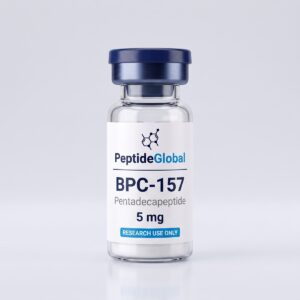
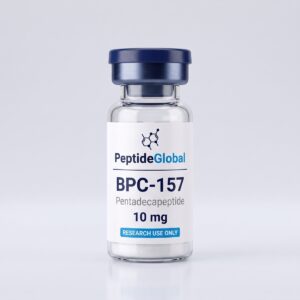
Peptide Global does not supply BPC-157 on its own. It appears as a component of three multi-peptide cartridges:
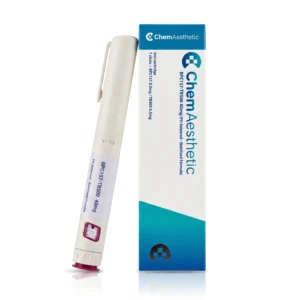
- BPC-157 + TB-500 Pen 40 mg — the two compounds together, 40 mg total in a 3 ml cartridge at 13.33 mg/ml.
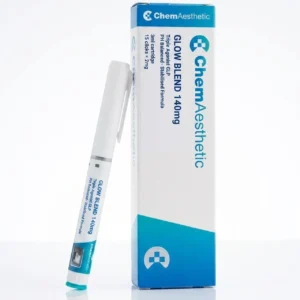
- Glow Peptide Pen 140 mg — with GHK-Cu and TB-500, 140 mg total in 3 ml.
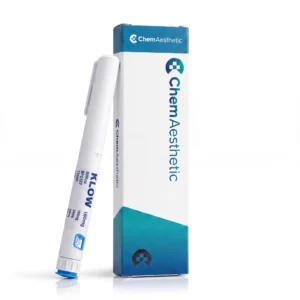
- KLOW Peptide Pen 160 mg — the Glow components plus KPV, 160 mg total in 3 ml.
In every case the cartridge publishes its split, and BPC-157 is present at 20 mg — 6.67 mg/ml in the 3 ml fill — in all three. So an experiment needing a known concentration of BPC-157 can have one from any of them; at the 0.01 ml dial increment each click delivers 0.067 mg of it. What a blend fixes is the ratio to the other components, not the information about BPC-157 itself. See blends versus single compounds.
Storage is 2–8 °C, protected from light, not frozen. See storage and handling.
Common questions
What is BPC-157?
A synthetic 15-amino-acid peptide whose sequence corresponds to a partial sequence within a larger protein described in human gastric juice. The parent protein occurs naturally; BPC-157 itself is a synthesised fragment of its sequence, and a fragment is a distinct molecule rather than a portion of the parent's activity.
Does BPC-157 have a known receptor?
No consensus one. This is the central open question about the compound: mechanistic accounts in the literature describe pathways it has been reported to influence — angiogenic signalling, cell migration — rather than a binding site it is known to occupy. Target identification is an active area.
Is BPC-157 banned?
It was added to the World Anti-Doping Agency's prohibited list in 2022, under the category for non-approved substances, and is prohibited at all times rather than only in competition. That is a sports-regulation matter; it does not bear on the research-use-only basis on which this material is supplied.
Can I buy BPC-157 on its own?
Not from Peptide Global. It is supplied only as a component of the BPC-157 + TB-500, Glow and KLOW pens — at 20 mg in each, which is 6.67 mg/ml in the 3 ml cartridge. Each of those pages publishes the full split, so the BPC-157 concentration is a stated figure rather than an unknown.
How is BPC-157 different from TB-500?
Different parent molecules entirely: BPC-157 derives from a gastric-juice protein sequence, TB-500 from thymosin β4. TB-500 has a comparatively well-defined mechanistic handle in actin binding, whereas BPC-157 has no consensus receptor. The comparison guide sets this out in full.
Is BPC-157 legal in the UK?
BPC-157 holds no UK marketing authorisation and no licensed medicine contains it. Material supplied for in-vitro laboratory research sits outside the medicines framework rather than being prohibited by it. Separately, BPC-157 has been on the World Anti-Doping Agency's prohibited list since 2022, prohibited at all times — a sports-regulation matter rather than a medicines one, though it may bear on an institution's own rules. Nothing here is legal advice.
Products described in this guide
Supplied for laboratory research use only. UK delivery is £4.95, free on orders over £100, tracked as standard.
Continue reading
Research use only
Every compound named on this page is supplied by Peptide Global strictly for laboratory research use only. Nothing here is for human or veterinary use. These are not foods, supplements or cosmetics, and they are not intended to diagnose, treat, cure or prevent any disease. Nothing on this page is medical, veterinary or legal advice, and no part of it describes administration to a person or an animal.
Purchasers are responsible for their own compliance with applicable law and with the requirements of their institution or ethics committee. At checkout, purchasers confirm they are a qualified researcher aged 18 or over and that they accept the Research-Use-Only Policy and Terms & Conditions.