What a blend is
A blend cartridge holds two or more peptides combined at manufacture in a fixed ratio and supplied in one sealed container. The ratio is the same in every cartridge of that product; it is set once, during filling, rather than assembled by the researcher.
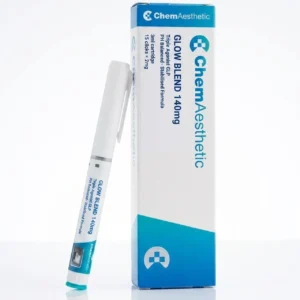
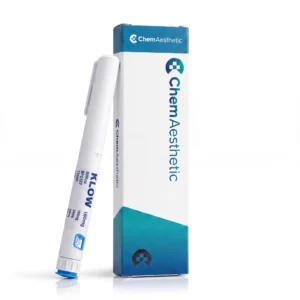
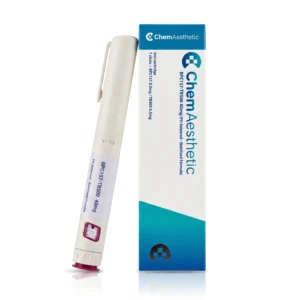
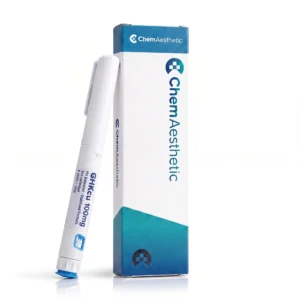
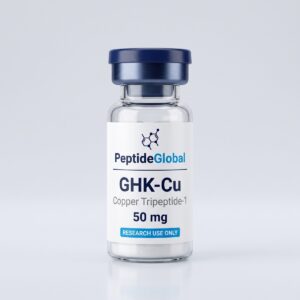
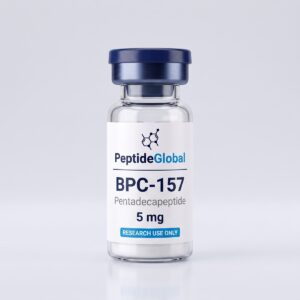
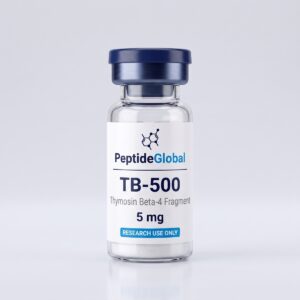
Peptide Global supplies three: the BPC-157 + TB-500 Pen 40 mg with two components, the Glow Peptide Pen 140 mg with three, and the KLOW Peptide Pen 160 mg with four. All are 3 ml cartridges, and all are pre-mixed in the same way as the single-compound pens.
Blend names are trade names, not specifications. There is no standard defining what "Glow" or "KLOW" contains, so another supplier's product of the same name may hold different components or a different ratio without being wrong about anything. The component list and the total mass are the specification.
The figure that matters is the split
Most blend listings in this market state a total mass and stop there. Ours state the split, and that one difference decides what the format can be used for — so it is the first thing to check on any blend, ours or anyone else's.
Where the split is published, a per-component concentration is a known figure. Every blend in this range is filled at the same per-component concentrations as the corresponding single-compound pens: GHK-Cu at 33.33 mg/ml, and BPC-157, TB-500 and KPV at 6.67 mg/ml each. So the Glow pen's 140 mg is 100 + 20 + 20, the KLOW pen's 160 mg is 100 + 20 + 20 + 20, and the BPC-157 + TB-500 pen's 40 mg is 20 + 20. At the 0.01 ml dial increment that is 0.333 mg of GHK-Cu and 0.067 mg of each other component per click.
Where the split is not published, none of that holds. A cartridge stating only "80 mg total" cannot establish a concentration of anything, and the arithmetic cannot be recovered — the input is simply absent. Assuming an even split and reporting a figure from it produces a fabricated number. That failure is real; it just is not a property of these products.
What a fixed ratio does cost you is independent control. GHK-Cu sits at five parts to every one of the others, and that proportion is set at manufacture. Dispensing more to raise the BPC-157 concentration raises the GHK-Cu concentration five times as fast. Where a design needs the components at concentrations chosen independently of one another, it needs them in separate containers, and in this catalogue only GHK-Cu is sold both ways.
And within one experiment a blend still cannot attribute an observation to one component. Several peptides were present, so the result belongs to the mixture. That is a limit of the experimental design rather than of the specification, and it is answered by running single-compound controls alongside — a different problem from not knowing what is in the cartridge.
What a blend is genuinely good for
None of that makes the format pointless, and it would be dishonest to present the limitations without the other side.
The ratio being fixed is the format's actual strength. Every cartridge of a given product presents the same combination in the same proportions, so results obtained across a series are comparable to one another even though they cannot be attributed to a constituent. A researcher asking whether a particular combination does something, consistently, has a format that answers that question with less preparation variability than assembling the mixture by hand would introduce.
Assembling it by hand is the relevant comparison, and it is not free. Combining three peptides at the bench means three measurements, three transfers and three opportunities for the achieved ratio to differ from the intended one — and it produces a mixture whose ratio is reproducible only as far as the technique is. A factory-filled cartridge removes that, in exchange for not telling you the ratio.
Combination effects are also a legitimate object of study in their own right. Whether components in combination behave as the sum of their separate behaviours is a real question, and it needs the combination to ask.
Handling: strictest component wins
A blend inherits the most demanding handling requirement of any of its components rather than an average of them, because all of them share one solution.
For the Glow and KLOW cartridges that requirement is set by GHK-Cu: a copper coordination complex, sensitive to pH and to competing chelators, with a redox-active metal at its centre. So light protection and refrigeration apply to the whole cartridge, not only to its GHK-Cu content.
There is also no way to assess the components separately. Any judgement about a cartridge's condition is a judgement about the mixture — it cannot be established that three components are unaffected and one is not. Stated conditions are 2–8 °C, protected from light, not frozen, for as long as the cartridge is held: see how to store research peptides.
Choosing between them
One question decides it, and it is not the one this guide used to ask. Does the experiment need the components at concentrations chosen independently of each other?
If yes, buy them separately — no fixed-ratio cartridge can serve, however convenient. If no, and the question concerns the combination as a combination at a ratio you are content with, a blend is the better choice: the ratio is identical in every cartridge, the per-component concentrations are stated, and the preparation variance of mixing three or four peptides by hand is removed.
Two failure modes are worth naming. The first is buying a blend that publishes only a total and then reporting a component concentration derived by assuming an even split — a fabricated number. The second is buying separate vials for a study that never needed independent concentrations, and absorbing three or four times the preparation variance for nothing.
Common questions
How much of each peptide is in a blend pen?
It is stated on each product page. BPC-157 + TB-500 is 20 mg each; Glow is GHK-Cu 100 mg with BPC-157 and TB-500 at 20 mg each; KLOW adds KPV at 20 mg. In every case that is 33.33 mg/ml of GHK-Cu and 6.67 mg/ml of each other component — the same concentrations as the single-compound pens.
Can a blend be used to establish a concentration of one component?
With ours, yes — the split is published, so the concentration of each component in a dispensed volume is a stated figure. With a blend listing only a total, no: the input the calculation needs is genuinely absent, and an assumed even split is a fabricated number. Check which kind of listing you are reading.
Is a blend worse than buying the compounds separately?
Not worse, different. A fixed ratio removes the preparation variance of mixing three or four peptides by hand and gives an identical combination in every cartridge. What it removes is the ability to set each concentration independently — and, within a single experiment, the ability to attribute a result to one component without separate controls.
Can I compare a blend and a single-compound pen on price per milligram?
Only component by component. Because the blends carry GHK-Cu at the same 33.33 mg/ml as the standalone pen, those portions compare directly. Total-peptide cost per milligram does not compare: GHK-Cu is the largest and cheapest part of both blends, so a blend's lower headline figure reflects composition rather than better value.
Do blends need different storage?
They inherit the strictest requirement of any component rather than an average, because all the components share one solution. For Glow and KLOW that is set by GHK-Cu, a copper complex sensitive to pH and to competing chelators — so light protection and refrigeration apply to the whole cartridge.
Products described in this guide
Supplied for laboratory research use only. UK delivery is £4.95, free on orders over £100, tracked as standard.
Continue reading
Research use only
Every compound named on this page is supplied by Peptide Global strictly for laboratory research use only. Nothing here is for human or veterinary use. These are not foods, supplements or cosmetics, and they are not intended to diagnose, treat, cure or prevent any disease. Nothing on this page is medical, veterinary or legal advice, and no part of it describes administration to a person or an animal.
Purchasers are responsible for their own compliance with applicable law and with the requirements of their institution or ethics committee. At checkout, purchasers confirm they are a qualified researcher aged 18 or over and that they accept the Research-Use-Only Policy and Terms & Conditions.