Why they are always paired
BPC-157 and TB-500 are mentioned together so consistently that they are often taken for variants of one thing. They are not related in any structural or mechanistic sense. What they share is a research context: both have been studied in connection with tissue repair and cell migration, and both arrived there by entirely separate routes.
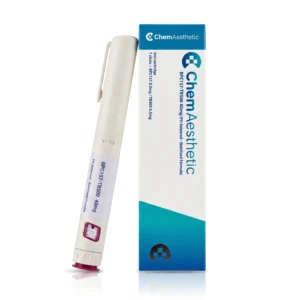
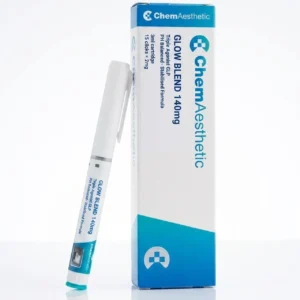
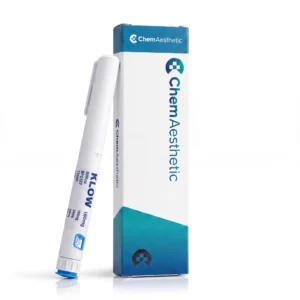
They are also supplied together, which reinforces the association. Peptide Global's BPC-157 + TB-500 Pen 40 mg holds both in one cartridge, and both also appear in the Glow and KLOW blends. Being sold in the same container is not evidence of pharmacological kinship.
Side by side
| BPC-157 | TB-500 | |
|---|---|---|
| Parent molecule | A protein described in gastric juice | Thymosin β4, 43 residues |
| Length as supplied | 15 residues | Short fragment, around residues 17–23 |
| Molecular target | No consensus receptor | Monomeric actin |
| Target measurable directly | No | Yes, in cell-free assay |
| Name ambiguity | Low — identifies one sequence | High — may mean the fragment or the whole protein |
| Available singly here | No | No |
| WADA prohibited list | Yes, added 2022 | Yes, as a thymosin β4 fragment |
The asymmetry that matters
The most consequential difference between these two compounds is not their sequences. It is that one has a target you can measure and the other does not.
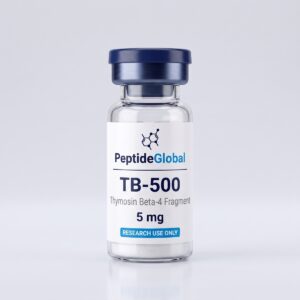
TB-500 corresponds to the actin-binding region of thymosin β4, and actin binding is a defined biochemical activity. It can be assayed in a cell-free system against purified protein, its effect on the balance between monomeric and filamentous actin can be quantified, and the contribution of individual residues can be tested by substitution. An experiment using TB-500 has something concrete to attribute a result to.
BPC-157 has no consensus molecular target. Mechanistic accounts in the literature describe pathways it has been reported to influence — angiogenic signalling, cell migration — rather than a binding site it is known to occupy. That is not a gap in a supplier's information; it is the state of the published science, and target identification remains an active area.
For anyone designing work, this asymmetry sets the agenda. A TB-500 experiment can be built around a defined interaction. A BPC-157 experiment has to be built around a phenotype, with the attribution problem handled by the design rather than assumed away. Comparing the two compounds in one assay is therefore harder than it looks: a shared readout such as wound closure will register both, and will not tell you why either worked.
Two fragments, two different parents
Both compounds are fragments, and both illustrate the same general point from opposite directions: a fragment is a distinct molecule, not a diluted version of its parent.
Thymosin β4 is a well-characterised intracellular actin-binding protein present widely in mammalian cells. TB-500's short motif reproduces the actin-binding function specifically, and whether it reproduces the parent protein's tissue-level behaviour is a genuinely open comparative question — which is itself a productive line of work.
BPC-157's parent is a protein described in human gastric juice, and here the relationship is less well characterised in both directions: the parent is less studied than thymosin β4, and what the fragment retains of it is correspondingly harder to state. The compound is, in effect, better characterised phenomenologically than it is with respect to its own origin.
One name is precise, the other is not
A practical difference that matters at the point of ordering: "BPC-157" identifies one 15-residue sequence, whereas "TB-500" does not reliably identify anything. The latter is a supplier-side label used inconsistently — most often for the short actin-binding fragment, sometimes loosely for full-length thymosin β4, which is a materially different molecule with a different mass.
So two listings both reading "TB-500" may not be the same compound, and comparing their prices settles nothing. Compare the stated sequence or mass instead. The general form of this problem is covered in what to check before ordering.
How they are supplied here
Neither compound is available on its own from Peptide Global. Both appear together in the BPC-157 + TB-500 Pen 40 mg — 20 mg of each in a sealed 3 ml cartridge, so 6.67 mg/ml apiece, the same concentration as a 20 mg single-compound pen — and in the Glow and KLOW blends at 20 mg each there too.
Because that split is published, the cartridge does establish a concentration of each compound: at the 0.01 ml dial increment, one click delivers 0.067 mg of each. What it cannot do is vary them independently — the ratio is 1:1 and fixed — or, within a single experiment, attribute an observation to one rather than the other. That second limit is the one this comparison actually runs into, and it is answered by single-compound controls rather than by a different cartridge. See blends versus single compounds.
Common questions
Are BPC-157 and TB-500 related?
No. They derive from unrelated parent molecules — BPC-157 from a protein described in gastric juice, TB-500 from thymosin β4 — and share no structural or mechanistic relationship. What they share is a research context around tissue repair and cell migration, and the fact that they are frequently sold together.
Which of the two has a known mechanism?
TB-500, to the extent that actin binding is a defined and directly measurable activity. BPC-157 has no consensus molecular target; accounts of its mechanism describe pathways it has been reported to influence rather than a binding site it is known to occupy.
Why does that difference matter for an experiment?
Because it determines what a result can be attributed to. A TB-500 experiment can be built around a defined interaction assayed in a cell-free system; a BPC-157 experiment has to be built around a phenotype with the attribution problem handled by the design. A shared readout such as wound closure registers both and explains neither.
Can I buy them separately?
Not from Peptide Global. They are supplied together in the BPC-157 + TB-500 pen at 20 mg each, and both appear in the Glow and KLOW blends at 20 mg each there too. Every one of those cartridges publishes its split, so each works out at 6.67 mg/ml of each component — the same concentration as a 20 mg single-compound pen.
Are BPC-157 and TB-500 banned in sport?
Both fall under the World Anti-Doping Agency's prohibited list and are prohibited at all times rather than only in competition — BPC-157 added in 2022, TB-500 as a thymosin β4 fragment. That is a sports-regulation matter and does not bear on the research-use-only basis of supply here.
Products described in this guide
Supplied for laboratory research use only. UK delivery is £4.95, free on orders over £100, tracked as standard.
Continue reading
Research use only
Every compound named on this page is supplied by Peptide Global strictly for laboratory research use only. Nothing here is for human or veterinary use. These are not foods, supplements or cosmetics, and they are not intended to diagnose, treat, cure or prevent any disease. Nothing on this page is medical, veterinary or legal advice, and no part of it describes administration to a person or an animal.
Purchasers are responsible for their own compliance with applicable law and with the requirements of their institution or ethics committee. At checkout, purchasers confirm they are a qualified researcher aged 18 or over and that they accept the Research-Use-Only Policy and Terms & Conditions.