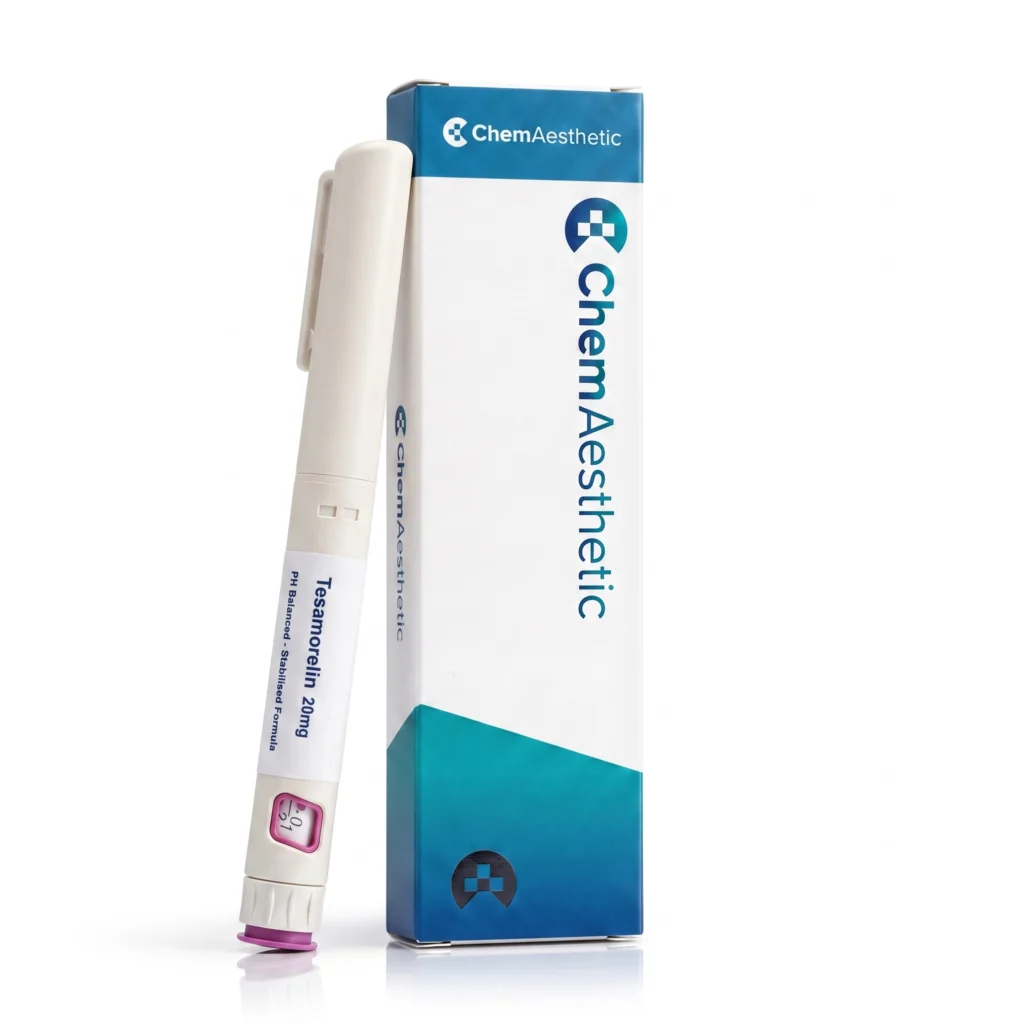
Labs studying the growth-hormone axis at the hypothalamic end — a GHRH analogue acting upstream of pituitary release rather than on the receptor directly.
The molecule is approved in the US as Egrifta for HIV-associated lipodystrophy. It is not authorised in the UK, and this material is supplied for laboratory research only.
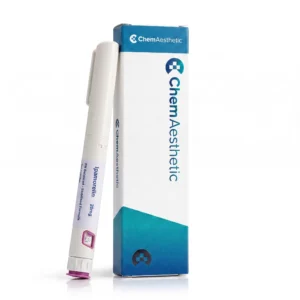
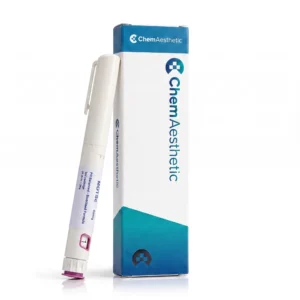
Tesamorelin Peptide Pen (GHRH Analogue) | 20mg
Held and dispatched from the UK — cold chain from storage to door Held & dispatched from the UK
20 mg Tesamorelin in a pre-mixed 3 ml cartridge. GHRH analogue. For laboratory research use only.
- Pre-mixed, no reconstitution required
- Sealed pharmaceutical pack
- UK delivery £4.95, free over £100
Bulk order & save
96 in stock · ready to dispatch
Same-day dispatch on orders placed before 2pm, Monday to Friday.
Product description
Tesamorelin is a synthetic analogue of human growth-hormone-releasing hormone, supplied here pre-mixed at 20 mg in a 3 ml stabilised cartridge. It arrives as a solution at a known concentration of 6.67 mg/ml, so there is no lyophilised powder to reconstitute and no bacteriostatic water to source separately.
What tesamorelin is
Native GHRH is a 44-amino-acid peptide released by the hypothalamus. Tesamorelin reproduces that full 44-residue sequence and adds a trans-3-hexenoyl group at the N-terminus. That single modification is the point of the molecule: unmodified GHRH is cleaved rapidly at the Tyr1–Ala2 bond by dipeptidyl peptidase-4, and the N-terminal acylation slows that cleavage substantially, giving a peptide with the same receptor target and a longer measurable half-life in plasma.
It is worth being precise about which analogue this is, because the GHRH family is often listed loosely. Sermorelin reproduces only the first 29 residues, the shortest fragment that retains full activity at the receptor. CJC-1295 is a further-modified 29-residue construct. Tesamorelin is the full-length 44-residue form. All three act at the same GHRH receptor; they differ in length, in how they resist enzymatic degradation, and consequently in their pharmacokinetic profile.
Tesamorelin pen: the same thing under a shorter name
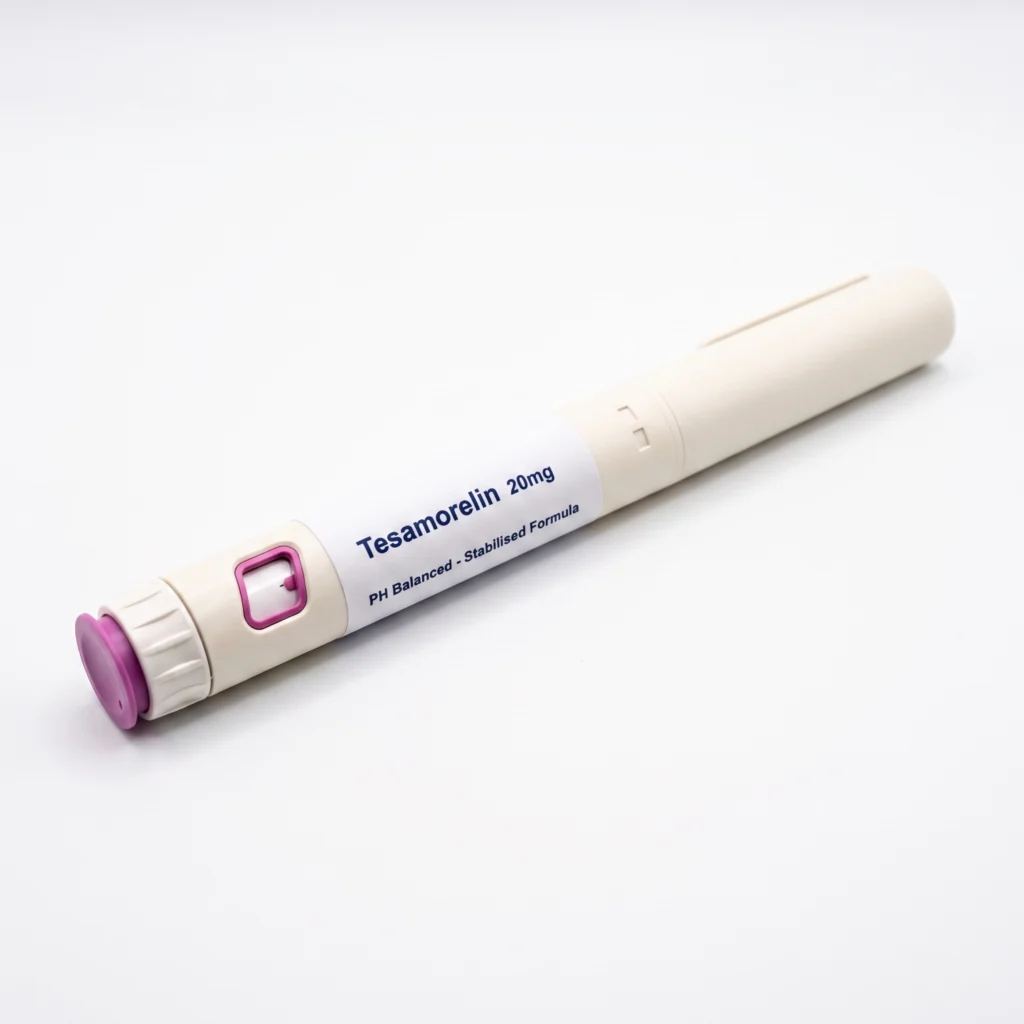
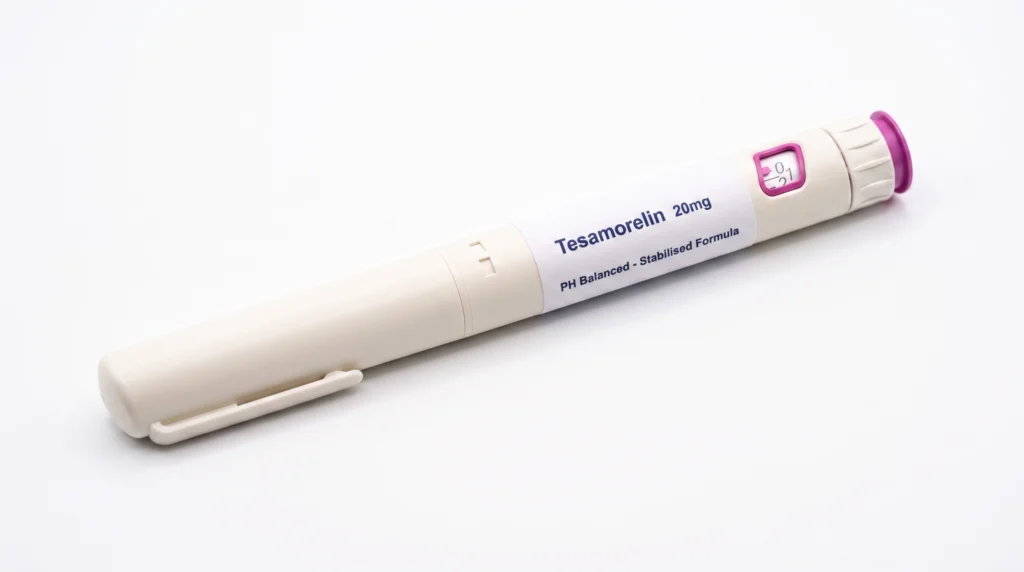
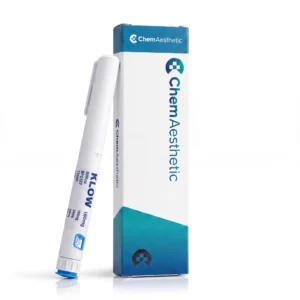
Most people searching for this product type “tesamorelin pen” rather than the full compound name, and the two mean the same thing. A tesamorelin pen is a pre-filled tesamorelin cartridge in a dial-dosing pen, as opposed to lyophilised powder in a vial.
This pen holds 20 mg in a sealed 3 ml cartridge, at 6.67 mg/ml. The dial is graduated at 30 clicks = 2 mg. Those are device figures — what the mechanism displaces, not what should be dispensed.
Applications in research
Because tesamorelin is a receptor-selective analogue with a well-characterised stability modification, it appears in laboratory work as a comparator rather than as a novel agent:
- GHRH receptor pharmacology. Binding and functional assays at the GHRH receptor, a class B G-protein-coupled receptor signalling through adenylyl cyclase and cAMP, where a full-length agonist is needed alongside truncated fragments.
- Enzymatic stability comparisons. Side-by-side DPP-4 digestion studies against native GHRH(1–44) and GHRH(1–29), where the N-terminal hexenoyl group is the only structural variable.
- Somatotroph culture models. Pituitary cell preparations in which growth-hormone release is the measured output and a stable secretagogue is required across a long incubation.
- Pulsatility and feedback modelling. Work on the GHRH–somatostatin–IGF-1 axis, where the compound's slower degradation changes the shape of the stimulus applied to the system.
Published human data on tesamorelin comes from a specific clinical context and a narrow indication. That literature describes the molecule; it says nothing about this material, which is not supplied for administration to anyone.
Is tesamorelin available in the UK?
Tesamorelin is approved by the FDA in the United States, under a brand name, for one narrow indication. It holds no marketing authorisation from the MHRA and is not a licensed medicine in the United Kingdom, so there is no legitimate route to obtain it here for human use.
Buying and possessing tesamorelin in the UK for laboratory research is lawful. It is not a controlled drug under the Misuse of Drugs Act 1971. What is unlawful is supplying it for human or veterinary consumption, which would engage the Human Medicines Regulations 2012. Every cartridge is labelled and supplied strictly for in-vitro research use.
How tesamorelin differs from an incretin analogue
Tesamorelin is frequently grouped with the GLP-1 and GIP receptor agonists, and mechanistically it does not belong with them. The distinction is not a matter of degree:
- Receptor. Tesamorelin is an agonist at the GHRH receptor on pituitary somatotrophs. The incretin analogues act at the GLP-1 and GIP receptors, which are distributed quite differently — pancreatic islet, gut and central nervous system tissue among others.
- Pathway. Tesamorelin acts one step upstream of growth hormone, so its measurable output is endogenous GH release and, downstream, hepatic IGF-1. Incretin analogues act on insulin secretion, glucagon suppression and gastric motility. There is no shared node between the two mechanisms.
- Class of molecule. Both are acylated peptide analogues of a native human hormone, and the resemblance ends there. The hormones they copy do unrelated jobs.
What you are actually comparing between listings
Tesamorelin listings look similar on price and differ substantially in what arrives. Three things decide the comparison:
- Total mass. This cartridge holds 20 mg. The usual presentations elsewhere are 5 mg and 10 mg vials, so a single unit here carries two to four times the peptide of a typical listing. Headline price is not comparable across those.
- Format. Pre-mixed solution at a stated 6.67 mg/ml against lyophilised powder that must be reconstituted, which means sourcing bacteriostatic water, calculating a concentration and accepting whatever variance that step introduces between preparations.
- Cost per milligram. At £160 for 20 mg this works out at £8.00 per mg. That is the figure to compare, not the price on the button.
For the other pen acting on the growth-hormone axis, Ipamorelin Pen 20mg is a ghrelin-receptor secretagogue rather than a GHRH analogue — a different receptor reaching the same axis.
Handling and storage
Store at 2–8 °C and protect from light. Keep the cartridge sealed until use, then upright, and observe aseptic technique. Do not freeze: repeated freeze–thaw cycling is the usual cause of aggregation in peptide solutions, and a 44-residue peptide has more conformational freedom to lose than a short one. Orders placed before 2pm are dispatched the same working day, cold-packed, in plain outer packaging.
References
Literature on the molecule. These describe tesamorelin as a compound and none is a claim about this product.
- Falutz J, Allas S, Blot K, et al. Metabolic effects of a growth hormone-releasing factor in patients with HIV. N Engl J Med. 2007;357(23):2359–70. PMID 18057338.
- Dhillon S. Tesamorelin: a review of its use in the management of HIV-associated lipodystrophy. Drugs. 2011;71(8):1071–91. PMID 21668043.
- Spooner LM, Olin JL. Tesamorelin: a growth hormone-releasing factor analogue for HIV-associated lipodystrophy. Ann Pharmacother. 2012;46(2):240–7. PMID 22298602.
Research use only
This material is supplied strictly for in-vitro research and analytical purposes. It is not for human or veterinary administration and not for any diagnostic or therapeutic application. It holds no MHRA marketing authorisation. Confirm the current regulatory position before drafting institutional documentation, and clear the material through your own ethics, COSHH and biosafety processes before ordering.
Specifications
| Compound | Tesamorelin |
|---|---|
| Designation | GHRH(1-44) analogue |
| Class | GHRH analogue |
| CAS number | 218949-48-5 |
| Molecular formula | C₂₂₁H₃₆₆N₇₂O₆₇S |
| Molecular weight | 5136 g/mol |
| Sequence | trans-3-hexenoyl-GRF(1-44)-NH2 (44 residues) |
| Strength | 20 mg per cartridge |
| Concentration | 6.67 mg/ml |
| Format | Pre-mixed dosing pen |
| Cartridge volume | 3 ml |
| Formulation | pH-balanced, stabilised |
| Storage | 2–8 °C, protect from light |
| Dose graduation | 30 clicks = 2 mg |
| Also known as | Tesamorelin peptide pen, Tesamorelin pre-mixed pen |
| SKU | PG-TESA-PEN-20 |
Storage and handling
| Reconstitution | Not required. Supplied pre-mixed in solution. |
|---|---|
| Sealed, as supplied | 2–8 °C, protect from light. Do not freeze. |
| Once in use | Return to refrigerated storage between use. Keep the cartridge upright. |
| Before dispensing | Allow the cartridge to reach room temperature. Do not shake. |
Frequently asked questions
What is the Tesamorelin Pen?
The Tesamorelin Pen is Tesamorelin supplied pre-mixed in a 3 ml dial-dosing cartridge rather than as lyophilised powder in a vial, so there is no reconstitution step. It is supplied for laboratory research use only.
How many clicks is 2 mg on the Tesamorelin Pen 20mg?
30 clicks. The dial is graduated at 30 clicks = 2 mg, so 2 mg is 30 clicks of the dial. A 20 mg cartridge holds 10 such increments. The concentration is fixed at manufacture, so the same click count dispenses the same volume every time. Protocol design is a matter for the researcher.
How much is the Tesamorelin Pen 20mg?
Tesamorelin Pen 20mg is £160.00. UK delivery is £4.95, free on orders over £100, tracked as standard.
What strength is the Tesamorelin Pen?
Each cartridge holds 20 mg. The cartridge volume is 3 ml.
How many 2 mg increments does the Tesamorelin Pen 20mg dispense?
A 20 mg cartridge dispenses 10 increments of 2 mg, each 30 clicks of the dial. The concentration is fixed at manufacture, so a given click count dispenses the same volume every time. Protocol design is a matter for the researcher.
How is the Tesamorelin Pen dial graduated?
The dial is graduated at 30 clicks = 2 mg, so the same volume can be dispensed repeatably between measurements.
Does the Tesamorelin Pen need reconstituting?
No. This is supplied as a pre-mixed pen, so there is no manual reconstitution step and no handling variability between preparations.
How should the Tesamorelin Pen be stored?
Store at 2–8 °C, protect from light. Once in use, keep the cartridge upright and observe aseptic handling practice.
How quickly is the Tesamorelin Pen dispatched?
Orders placed before 2pm are dispatched the same working day, cold-packed in thermal-insulated, tamper-evident packaging.
Is there a 40mg or 60mg tesamorelin pen?
Not from Peptide Global. Tesamorelin is supplied at one strength, 20 mg in a 3 ml cartridge at 6.67 mg/ml. Higher-strength listings elsewhere may be a different fill volume or a blend, so compare the stated mass and volume rather than the headline figure.
What is the difference between tesamorelin and ipamorelin?
The receptor each one acts at. Tesamorelin is a GHRH analogue acting at the GHRH receptor; ipamorelin acts at the ghrelin receptor, GHS-R1a. Both sit upstream of growth hormone release but enter the axis at different points, so they are not interchangeable in an experiment.
Is the Tesamorelin Pen for human use?
No. Everything supplied by Peptide Global is strictly an in-vitro research compound for laboratory research professionals. It is not for human or veterinary use.

Shipping & handling
- Order before 2pm GMT for same-working-day dispatch
- Tracked UK next-day · tracked EU & worldwide options
- Cold-packed in thermal, tamper-evident packaging
- Thermal-insulated, tamper-evident outer box
Guides on this compound
Reference material on what this compound is, how the pre-mixed format works, and the conditions it is held under. Written for laboratory researchers.
- What is tesamorelin? 4 min read
- Tesamorelin vs ipamorelin 4 min read
- What is ipamorelin? 4 min read
- What is CJC-1295? 5 min read