The difference in one line
Tesamorelin acts at the GHRH receptor. Ipamorelin acts at the ghrelin receptor, GHS-R1a. Both sit upstream of growth hormone release, both are described as acting on the growth hormone axis, and they share no receptor. They enter the same system at two different points.
Neither is growth hormone, and neither acts at the growth hormone receptor. Both act one step before it.
Side by side
| Tesamorelin | Ipamorelin | |
|---|---|---|
| Class | GHRH analogue | Growth hormone secretagogue |
| Receptor | GHRH receptor | Ghrelin receptor (GHS-R1a) |
| Based on | Human GHRH(1–44) | Earlier growth hormone-releasing peptides |
| Chain length | 44 residues plus a terminal cap | 5 residues |
| Molecular weight | About 5136 g/mol | 711.9 g/mol |
| Design problem solved | Rapid cleavage by DPP-4 | Off-target hormonal activity |
| Authorisation | Authorised in the US (Egrifta); not aware of a UK one | None; clinical development discontinued |
| Supplied here as | 20 mg pen | 20 mg pen, 5 mg and 10 mg vials |
Two entry points to one axis
Growth hormone release from the pituitary is governed by two opposing hypothalamic signals: growth hormone-releasing hormone pushing release, and somatostatin restraining it. Ghrelin, acting at its own receptor, is a third input.
Tesamorelin is an analogue of the releasing hormone itself, so it acts at the receptor the hypothalamic signal uses. Ipamorelin acts at the ghrelin receptor, a separate protein with its own signalling, and that pathway is also reported to reduce somatostatin's restraining effect.
The experimental consequence is that a result obtained with one cannot be attributed to the other. They are not stronger and weaker versions of the same thing, and they are not substitutes. They also differ in the standard functional readout: cyclic AMP accumulation for the GHRH receptor, calcium mobilisation or inositol phosphate accumulation for GHS-R1a.
They were built to solve different problems
Tesamorelin's design problem was durability. Native GHRH is inactivated within minutes by dipeptidyl peptidase-4, which cuts near the amino terminus. Tesamorelin keeps the native 44-residue sequence and adds a trans-3-hexenoyl group at that end, which the enzyme cannot process. The receptor-binding character is essentially unchanged; the molecule simply lasts longer.
Ipamorelin's design problem was selectivity. Earlier compounds acting at the ghrelin receptor were reported to raise ACTH, cortisol and prolactin as well, which made any observation hard to interpret. Ipamorelin was characterised as producing markedly less of that accompanying activity relative to those named predecessors, which is what makes it useful as a tool compound for one pathway.
So one is a natural sequence made durable, and the other is a small engineered sequence made selective. Very different molecules for very different reasons, which is a better summary than any single "which is better" answer.
Why the size difference matters at the bench
At roughly 5136 g/mol, tesamorelin is about seven times the mass of ipamorelin per molecule. A 20 mg tesamorelin pen and a 20 mg ipamorelin pen hold the same mass at the same 6.67 mg/ml, but the ipamorelin cartridge contains around seven times as many molecules. Any comparison prepared on a molar basis needs that conversion done from the actual molecular weights rather than from the label strength.
Length also bears on handling. Longer peptides in solution are generally less forgiving of temperature excursions and freeze–thaw cycling than short ones, which is one reason the storage conditions for the tesamorelin pen deserve particular attention. Both pens are stored at 2–8 °C, protected from light and not frozen.
What about a tesamorelin and ipamorelin blend?
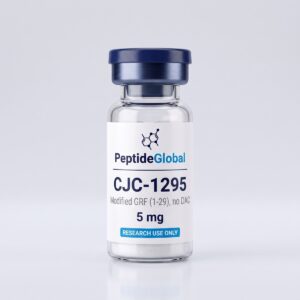
Blended pens combining the two circulate in this market. Peptide Global does not supply one, for the same reason it supplies CJC-1295 and ipamorelin separately: a fixed-ratio mixture cannot tell you which component produced an observation, and the ratio cannot be varied to find out. Separate pens or vials let each be studied alone, together, and at a chosen ratio. The argument is set out in blends versus single compounds, and the closely related pairing is covered in CJC-1295 and ipamorelin.
How they are supplied
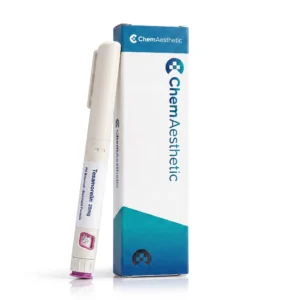
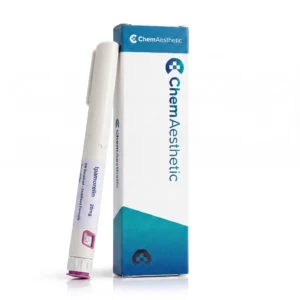
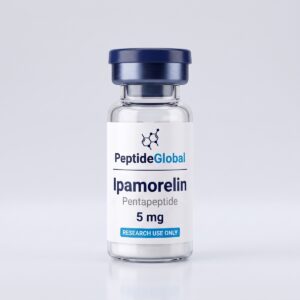
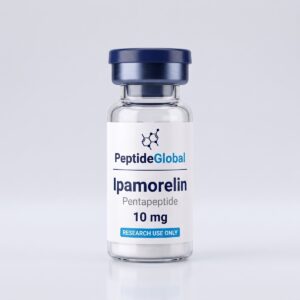
The Tesamorelin Pen 20 mg and the Ipamorelin Pen 20 mg are identical in format: 20 mg pre-mixed in a sealed 3 ml cartridge at 6.67 mg/ml, with no reconstitution step. Tesamorelin is supplied at that one strength only. Ipamorelin is also available as lyophilised powder in 5 mg and 10 mg vials, where the working concentration is set by the volume of diluent added.
Common questions
What is the difference between tesamorelin and ipamorelin?
The receptor. Tesamorelin is a GHRH analogue acting at the GHRH receptor; ipamorelin is a secretagogue acting at the ghrelin receptor, GHS-R1a. Both sit upstream of growth hormone release but share no receptor, so they are not interchangeable in an experiment.
Is tesamorelin stronger than ipamorelin?
The comparison does not hold up. They act at different receptors, so potency at one says nothing about the other, and they are not two strengths of one mechanism.
Can tesamorelin and ipamorelin be studied together?
Yes, and because they act at separate receptors the combination is a coherent thing to study. Supplying them separately rather than as a blend is what allows each to be studied alone and the ratio between them to be varied.
Is there a tesamorelin and ipamorelin blend pen?
Not from Peptide Global. Both are supplied as separate 20 mg pens, and ipamorelin also as 5 mg and 10 mg vials.
Is there a 40 mg or 60 mg tesamorelin pen?
Not here. Tesamorelin is supplied at one strength, 20 mg in a 3 ml cartridge. Higher figures elsewhere may reflect a different fill volume or a blend, so compare mass and volume rather than the headline number.
Are tesamorelin and ipamorelin legal in the UK?
Tesamorelin is authorised in the United States under the brand name Egrifta, which confers no UK status, and we are not aware of a UK marketing authorisation. Ipamorelin holds none anywhere. Both are supplied for in-vitro laboratory research, which sits outside the medicines framework. Nothing here is legal advice.
Products described in this guide
Supplied for laboratory research use only. UK delivery is £4.95, free on orders over £100, tracked as standard.
Continue reading
Research use only
Every compound named on this page is supplied by Peptide Global strictly for laboratory research use only. Nothing here is for human or veterinary use. These are not foods, supplements or cosmetics, and they are not intended to diagnose, treat, cure or prevent any disease. Nothing on this page is medical, veterinary or legal advice, and no part of it describes administration to a person or an animal.
Purchasers are responsible for their own compliance with applicable law and with the requirements of their institution or ethics committee. At checkout, purchasers confirm they are a qualified researcher aged 18 or over and that they accept the Research-Use-Only Policy and Terms & Conditions.