Chemical identity
| Designation | Tesamorelin |
|---|---|
| CAS number | 218949-48-5 |
| Molecular formula | C221H366N72O67S |
| Molecular weight | 5136 g/mol |
| Chain | Human GHRH(1–44) with an N-terminal trans-3-hexenoyl group |
| Cartridge strength | 20 mg per cartridge |
| Concentration | 6.67 mg/ml |
| Presentation | Pre-mixed solution, sealed 3 ml cartridge |
| Storage | 2–8 °C, protect from light, do not freeze |
Identifiers verified against PubChem in both directions — name to compound record, then each CAS number back again — and, where the sequence is of standard residues, cross-checked by recomputing the molecular weight from the sequence. No purity, HPLC or certificate-of-analysis figure is stated, because no supplier data supports one.
What tesamorelin is
Tesamorelin is a synthetic analogue of human growth hormone-releasing hormone. The native hormone is a 44-residue peptide produced in the hypothalamus, and tesamorelin retains that sequence with one addition: a trans-3-hexenoyl group attached at the amino terminus.
That single modification is the whole design. Native GHRH is cleaved rapidly by dipeptidyl peptidase-4, which cuts near the amino terminus and inactivates the molecule within minutes. Capping that end with a group the enzyme cannot process leaves the receptor-binding character of the sequence essentially intact while removing the principal route of inactivation. It is a clean example of a general strategy in peptide design: change how long the molecule lasts without changing what it recognises.
Tesamorelin is authorised as a medicine in the United States, where it is marketed under the brand name Egrifta for a specific indication in HIV-associated lipodystrophy. That authorisation is a United States one. It confers no UK status, and we are not aware of a UK marketing authorisation for tesamorelin — the MHRA products register is the place to confirm that directly rather than take it on trust. Research-grade tesamorelin supplied here is in any case not that finished medicine and is not supplied as one.
Acting at the GHRH receptor
Tesamorelin acts at the GHRH receptor — the receptor the hypothalamic signal itself uses. This is what distinguishes it from a secretagogue such as ipamorelin, which acts at the ghrelin receptor instead. Both compounds engage the growth hormone axis; they enter it through different receptors, and a result obtained with one cannot be attributed to the other.
Neither is growth hormone. Tesamorelin does not act at the growth hormone receptor and is not a growth hormone analogue; it is an analogue of the hormone that triggers growth hormone release, which sits one step upstream. The distinction matters in an experiment, because the two act on different cells.
Because tesamorelin acts through the physiological receptor, work using it is often framed around the pattern of the resulting signal rather than only its magnitude — the native axis is pulsatile, and a stabilised analogue of the releasing hormone interacts with that differently from a molecule acting elsewhere.
What is studied in vitro
The primary assays are binding and function at the GHRH receptor: displacement of a labelled ligand to establish affinity, and cyclic AMP accumulation across a concentration range to establish potency, in cells expressing the receptor. Selectivity is confirmed against unrelated receptor panels.
Enzymatic stability is unusually central for this compound, because stability is the modification's entire purpose. Incubating the analogue and the native sequence side by side with a DPP-4 preparation, and tracking intact peptide over time, is the experiment that demonstrates what the hexenoyl group achieves. Comparable work in serum or plasma preparations gives a less clean but more representative picture.
Pituitary cell preparations are used to measure growth hormone release directly in response to receptor activation, and structure–activity work compares GHRH fragments and analogues against the same panel to establish which parts of the 44-residue sequence the receptor actually requires.
How it is supplied
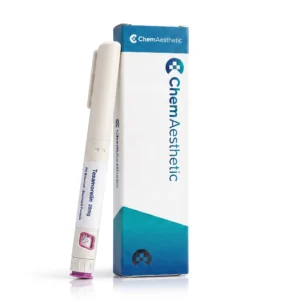
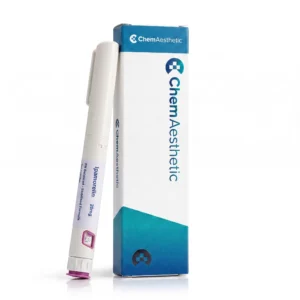
Peptide Global supplies it as the Tesamorelin Pen 20 mg: 20 mg pre-mixed in a sealed 3 ml cartridge at 6.67 mg/ml, in a dial-dosing pen device, with no reconstitution step and no bacteriostatic water.
One handling note is worth drawing out for this compound in particular. At 44 residues plus a modification, tesamorelin is among the longer chains in the catalogue, and longer peptides in solution are generally less forgiving of temperature excursions and freeze–thaw cycling than short ones. The stated conditions — 2–8 °C, protected from light, not frozen — apply for as long as the cartridge is held, not merely during transit. Orders leave cold-packed, and cold-packing covers the journey only. See how to store research peptides.
Common questions
What is tesamorelin?
A synthetic analogue of human growth hormone-releasing hormone: the native 44-residue sequence with a trans-3-hexenoyl group attached at the amino terminus. That cap blocks cleavage by dipeptidyl peptidase-4, the enzyme that inactivates native GHRH within minutes.
How does tesamorelin differ from ipamorelin?
The receptor. Tesamorelin acts at the GHRH receptor, the one the hypothalamic signal uses; ipamorelin acts at the ghrelin receptor. Both engage the growth hormone axis from different entry points, and they are not interchangeable in an experiment.
Is tesamorelin growth hormone?
No. It is an analogue of the hormone that triggers growth hormone release, not of growth hormone itself, and it does not act at the growth hormone receptor.
Is tesamorelin legal in the UK?
Tesamorelin is authorised in the United States under the brand name Egrifta for a specific indication, and a US authorisation confers no UK status. We are not aware of a UK marketing authorisation — the MHRA products register is the place to confirm directly. Research-grade material is not the finished medicine in any case, and is supplied for in-vitro laboratory research, which sits outside the medicines framework. Nothing here is legal advice.
What strength is the Tesamorelin Pen?
20 mg in a 3 ml cartridge, giving 6.67 mg/ml, supplied pre-mixed with no reconstitution step.
Products described in this guide
Supplied for laboratory research use only. UK delivery is £4.95, free on orders over £100, tracked as standard.
Continue reading
Research use only
Every compound named on this page is supplied by Peptide Global strictly for laboratory research use only. Nothing here is for human or veterinary use. These are not foods, supplements or cosmetics, and they are not intended to diagnose, treat, cure or prevent any disease. Nothing on this page is medical, veterinary or legal advice, and no part of it describes administration to a person or an animal.
Purchasers are responsible for their own compliance with applicable law and with the requirements of their institution or ethics committee. At checkout, purchasers confirm they are a qualified researcher aged 18 or over and that they accept the Research-Use-Only Policy and Terms & Conditions.