Chemical identity
| Component | CAS number | Molecular formula | Molecular weight | Sequence |
|---|---|---|---|---|
| CJC-1295 without DAC (Mod GRF 1-29) | 863288-34-0 | C152H252N44O42 | 3367.9 g/mol | 29 amino acids |
| CJC-1295 with DAC | 446262-90-4 | C165H269N47O46 | 3647.2 g/mol | 29 amino acids plus DAC linker |
| Cartridge strength | 5 mg no DAC, 2 mg with DAC, per vial |
|---|---|
| Concentration | Set on reconstitution |
| Presentation | |
| Storage | 2–8 °C, protect from light, do not freeze |
Two chemically distinct molecules share this name, differing by the 279.3 Da drug affinity complex. Verified 8 Sep 2026: CID 56841945 is the 3367.9 no-DAC molecule and contains no sulfur, consistent with the Met27 to Leu substitution; CID 91971820 is the 3647.2 DAC conjugate. PubChem synonyms label these two the wrong way round, listing the lighter unconjugated molecule as "CJC 1295 with DAC", so identity must be read from molecular weight and not from name or CAS.
Identifiers verified against PubChem in both directions — name to compound record, then each CAS number back again — and, where the sequence is of standard residues, cross-checked by recomputing the molecular weight from the sequence. No purity, HPLC or certificate-of-analysis figure is stated, because no supplier data supports one.
What is CJC-1295?
CJC-1295 is a synthetic analogue of growth hormone releasing hormone, built on the first twenty-nine residues of the natural hormone. That fragment, GRF (1-29), is the shortest piece of GHRH that retains activity at the receptor, and it is the same sequence marketed as sermorelin.
Four amino acid substitutions distinguish CJC-1295 from that parent fragment. Each one replaces a residue at a site where enzymes in plasma would otherwise cut the chain, so the molecule survives considerably longer than the unmodified fragment does. The substitution at position 27 swaps methionine for leucine, which is why the finished molecule contains no sulfur while sermorelin does.
It holds no marketing authorisation in any territory and is supplied here as research material only.
The two forms, and why the distinction matters
This is the single most confused product in the research peptide market, and the confusion is chemical rather than semantic. Two different molecules are sold under the name CJC-1295.
Without DAC, also written as Modified GRF (1-29) or Mod GRF 1-29, is the 29-residue peptide described above and nothing else. Molecular formula C152H252N44O42, molecular weight 3367.9.
With DAC carries an additional drug affinity complex: a maleimidoproprionyl group that forms a covalent bond with a cysteine residue on serum albumin. Molecular formula C165H269N47O46, molecular weight 3647.2.
The difference between those two figures is 279.3 Da, and that number is the whole story. Albumin circulates for roughly three weeks, so a peptide bound to it is carried along for as long as the carrier lasts. The no-DAC form has a half-life measured in minutes. The DAC form is measured in days.
Same receptor, same 29-residue core, entirely different exposure profile. They answer different research questions and they are not substitutes for one another.
How to tell which form you have
By molecular weight on the certificate of analysis, and only by that. The naming is unreliable in both directions.
PubChem holds both molecules but its synonym lists are contradictory. The entry at 3367.9 with no sulfur, which chemically must be the unconjugated peptide, is listed there under the synonym "CJC 1295 with DAC". The entry at 3647.2, which carries the extra 279 Da of linker, is listed as "GRF 1-29 (CJC1295)". Read on names alone and you get the two the wrong way round.
The CAS number most often quoted for CJC-1295, 863288-34-0, resolves to the 3367.9 molecule, so it refers to the no-DAC form despite being widely printed on DAC products.
The practical rule: ignore the name, ignore the CAS, and check the mass. Around 3368 is no DAC. Around 3647 is DAC. If a certificate gives no molecular weight, it is not telling you what is in the vial.
What is studied in vitro
GHRH receptor pharmacology is the primary strand. The receptor is a class B G protein-coupled receptor, so the standard readouts are cyclic AMP accumulation in cells expressing it, competition binding against a labelled reference ligand, and dose-response curves used to derive potency estimates.
The two forms are frequently run alongside each other, since a pair of molecules sharing a binding core but differing enormously in circulating persistence is a useful way to separate receptor-level potency from pharmacokinetics. Albumin binding itself is a second strand for the DAC form: whether the conjugate forms as intended, how completely, and whether the bound peptide retains activity.
Stability work matters more here than for most compounds, because resistance to enzymatic cleavage is the explicit design goal of the four substitutions. Comparisons against unmodified GRF (1-29) under the same conditions are the obvious experiment.
How it is supplied
Peptide Global supplies both forms as separate products, with the DAC status in the product name rather than hidden in a variant selector.
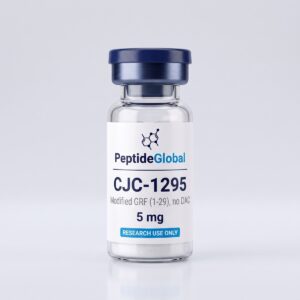
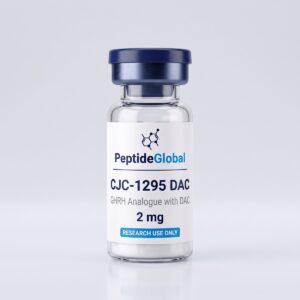
CJC-1295 no DAC is 5 mg of lyophilised powder in a sealed vial. CJC-1295 with DAC is 2 mg. The strengths differ because DAC-modified material is conventionally supplied at lower mass, so comparing the two on headline price compares two unlike things. Price per milligram is on each product page.
Both are freeze-dried and require reconstitution, which means you set the working concentration by choosing the diluent volume. See pens versus vials for why that matters, and bacteriostatic water and peptide stability for the handling.
CJC-1295 and sermorelin: the same 29 residues
The relationship between these two is worth setting out, because it explains what CJC-1295 actually is.
Sermorelin is GRF (1-29), the first twenty-nine residues of human growth hormone releasing hormone, unmodified. It is the parent sequence. CJC-1295 without DAC is that same twenty-nine residue chain with four amino acids swapped out.
The masses record the difference. Sermorelin is C149H246N44O42S at 3357.9. CJC-1295 without DAC is C152H252N44O42 at 3367.9, ten daltons heavier and with no sulfur atom. The missing sulfur is the clearest fingerprint of the modification, because the substitution at position 27 replaces methionine, the only sulfur-containing residue in the sequence, with leucine.
So three molecules sit in a line: the natural fragment, the protease-resistant version of it, and the albumin-binding version of that. Anyone comparing GHRH analogues is comparing points on that line rather than unrelated compounds.
What the four substitutions do
Each substitution addresses a specific vulnerability in the natural sequence rather than being an arbitrary change.
Position 2 becomes D-alanine. The natural residue there is the primary target of dipeptidyl peptidase-4, which clips two residues from the N-terminus and inactivates the fragment within minutes. Swapping in the D-isomer, the mirror image of the natural L form, leaves the enzyme unable to recognise the site.
Position 8 becomes glutamine and position 15 becomes alanine, both replacing residues prone to chemical rather than enzymatic degradation: asparagine deamidation and glycine-associated cleavage respectively. Position 27 becomes leucine, replacing the methionine that would otherwise oxidise.
Taken together the four changes convert a fragment with a half-life of minutes into one measured in hours, before any DAC conjugation is considered. That is the point of the design, and it is why the compound exists as a distinct entity rather than as a synonym for sermorelin.
Storage and handling
Both forms are supplied lyophilised and stored at minus twenty degrees, protected from light. A sealed freeze-dried vial is stable for far longer than a solution, which is the practical argument for the vial format over a pre-mixed one.
Once reconstituted the picture changes and the timeline shortens considerably. Allow the vial to reach room temperature before breaking the seal so condensation does not draw moisture into the cake, add diluent slowly down the inside wall rather than onto the powder, and swirl rather than shake. Agitation shears peptide chains, and a twenty-nine residue chain has more bonds to break than a tetrapeptide does.
Products described in this guide
Supplied for laboratory research use only. UK delivery is £4.95, free on orders over £100, tracked as standard.
Continue reading
Research use only
Every compound named on this page is supplied by Peptide Global strictly for laboratory research use only. Nothing here is for human or veterinary use. These are not foods, supplements or cosmetics, and they are not intended to diagnose, treat, cure or prevent any disease. Nothing on this page is medical, veterinary or legal advice, and no part of it describes administration to a person or an animal.
Purchasers are responsible for their own compliance with applicable law and with the requirements of their institution or ethics committee. At checkout, purchasers confirm they are a qualified researcher aged 18 or over and that they accept the Research-Use-Only Policy and Terms & Conditions.