Laboratories studying GHRH receptor pharmacology who need the short-acting analogue rather than the albumin-binding form.
No marketing authorisation in any territory. Frequently confused with the DAC form, which has a substantially longer half-life.
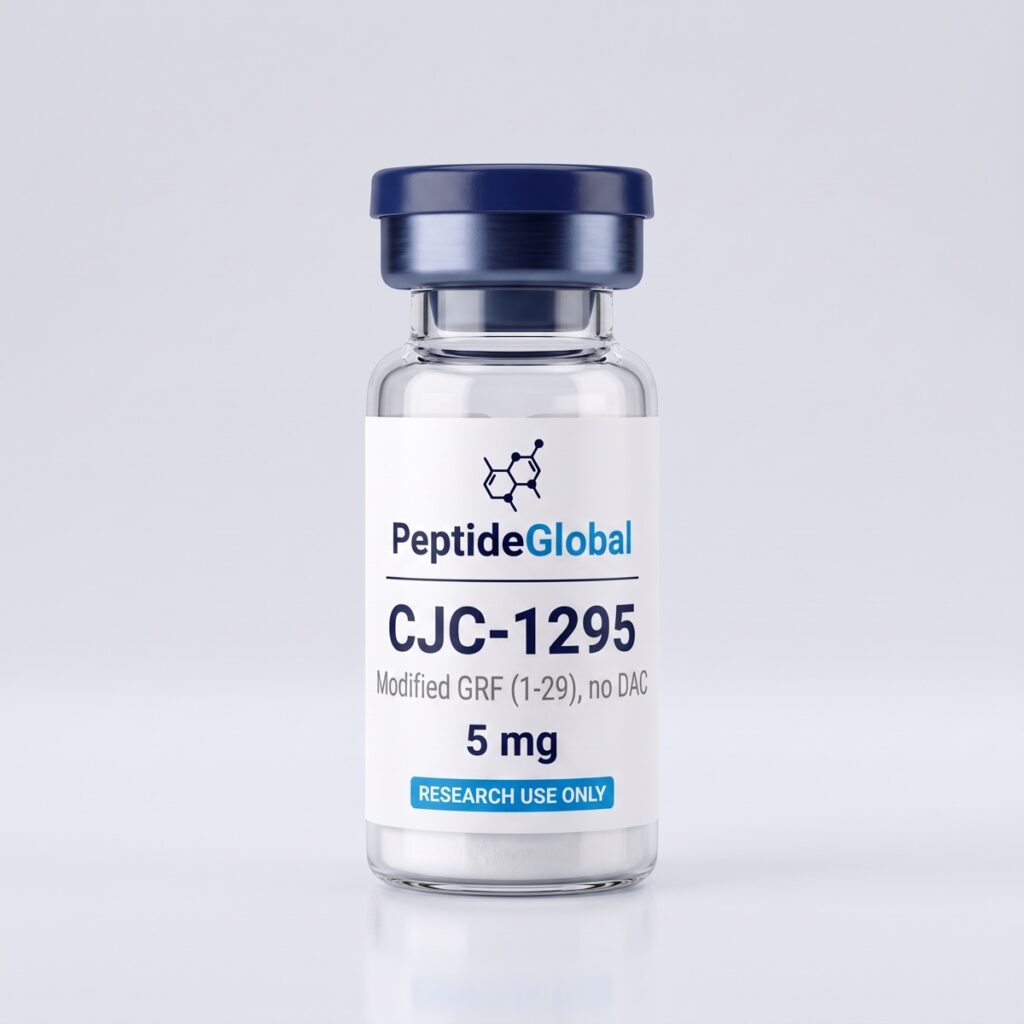
CJC-1295 no DAC 5mg Vial | Modified GRF (1-29)
Held and dispatched from the UK — cold chain from storage to door Held & dispatched from the UK
5 mg per vial CJC-1295 without DAC (Modified GRF 1-29) supplied as lyophilised powder in a sealed vial. For laboratory research use only.
- Lyophilised powder, reconstitute before use
- Sealed pharmaceutical pack
- UK delivery £4.95, free over £100
Bulk order & save
100 in stock · ready to dispatch
Same-day dispatch on orders placed before 2pm, Monday to Friday.
Product description
CJC-1295 without DAC, supplied as 5 mg of lyophilised powder in a sealed vial. A 29-residue GHRH analogue, also sold across this market as Modified GRF (1-29).
Read this first: two different compounds share this name
This is the single most confused product in the research peptide market, and the confusion is not trivial.
CJC-1295 without DAC, this product, is the 29-residue analogue with four amino acid substitutions that resist enzymatic degradation. Its half-life is measured in minutes.
CJC-1295 with DAC carries an additional drug affinity complex, a maleimido group that binds covalently to serum albumin. That single modification extends the half-life from minutes to days. It is a different molecule with different pharmacokinetics and a different molecular weight.
Suppliers list both as "CJC-1295" and buyers routinely receive the one they did not intend. The molecular weight on the certificate of analysis is how to tell them apart. We list them as separate products with the DAC status in the product name for exactly this reason.
Why the name Modified GRF (1-29)
GRF (1-29) is the first 29 residues of growth hormone releasing factor, the shortest fragment retaining activity — the same sequence marketed as sermorelin. Modified GRF (1-29) adds four substitutions to slow degradation. When a supplier writes "CJC-1295 no DAC" and another writes "Mod GRF 1-29", they are describing the same thing.
Why is CJC-1295 studied alongside Ipamorelin?
Searches for "CJC-1295 Ipamorelin" outnumber searches for CJC-1295 on its own, so the pairing deserves an explanation rather than an assumption.
The two act at different receptors. CJC-1295 is a GHRH analogue: it works at the growth hormone releasing hormone receptor, which governs how large a pulse the pituitary produces. Ipamorelin works at the ghrelin receptor, which governs when a pulse is triggered and also suppresses somatostatin, the brake on release.
Because the two mechanisms are separate rather than overlapping, they are frequently studied together in the literature on pulsatile secretion. One sets amplitude, the other sets timing. That is the whole reason the combination appears everywhere.
We supply them as separate single-compound vials rather than a premixed blend. A fixed-ratio blend cannot tell you which component produced an observed effect, which makes it unsuitable for research regardless of how convenient it is commercially. Studying them separately, or together at ratios you control, is the only way to get interpretable results.
Price per milligram
This vial is £34.99 for 5 mg, which is £7.00 per milligram. Comparing suppliers on price per milligram rather than headline price is the only like-for-like comparison, because vial strengths are not standardised across this market.
Does it come with a certificate of analysis?
Supplied with a batch-specific certificate of analysis stating the batch reference, identity confirmation, chromatographic purity against specification, and the analytical method used. Purity by reverse-phase HPLC with mass spectrometric identity confirmation, and the certificate names the laboratory that performed the work.
How is it reconstituted?
Allow the sealed vial to reach room temperature before breaking the seal, which prevents condensation drawing moisture into the cake. Add bacteriostatic water slowly down the inside wall rather than directly onto the powder, then swirl gently until clear. Do not shake: agitation shears peptide chains. The volume added sets the working concentration, so calculate it before opening anything.
Cold chain and UK dispatch
Held at −20 °C from arrival to dispatch and shipped insulated with a cold pack, tracked. Return the vial to cold storage on arrival. Short transit excursions do not compromise a sealed lyophilised vial.
Supplied strictly for laboratory research use only. Not for human or veterinary use, and not for diagnostic or therapeutic application. Purchasers must be 18 or over and are responsible for compliance with the rules applying to them.
Specifications
| Compound | CJC-1295 without DAC (Modified GRF 1-29) |
|---|---|
| Form | Lyophilised powder |
| Strength | 5 mg per vial |
| Residues | 29 amino acids |
| Presentation | Sealed glass vial, flip-off cap |
| Purity | ≥98% by RP-HPLC |
| Storage | −20 °C, protect from light |
| SKU | PG-CJCND-VIAL-5 |
Storage and handling
| Reconstitution | Required. Reconstitute with bacteriostatic water before use. |
|---|---|
| Sealed, as supplied | −20 °C, protect from light. Do not freeze. |
| Once in use | Return to refrigerated storage between use. Keep the cartridge upright. |
| Before dispensing | Allow the cartridge to reach room temperature. Do not shake. |
Frequently asked questions
What is the Modified GRF 1-29 pen?
The Modified GRF 1-29 pen is CJC-1295 without DAC (Modified GRF 1-29) supplied as 5 mg of lyophilised powder in a sealed vial, for reconstitution in the laboratory at whatever concentration the work requires. It is supplied for laboratory research use only.
How much is the CJC-1295 no DAC 5mg Vial?
CJC-1295 no DAC 5mg Vial is £34.99. UK delivery is £4.95, free on orders over £100, tracked as standard.
What strength is the CJC-1295 no DAC Vial?
Each vial holds 5 mg.
How is the Modified GRF 1-29 pen reconstituted?
Yes. This is supplied as a lyophilised powder, so it is reconstituted in the laboratory with bacteriostatic water added slowly down the vial wall and swirled rather than shaken. The volume added sets the working concentration.
How should the CJC-1295 no DAC Vial be stored?
Store at −20 °C, protect from light. Allow a sealed vial to reach room temperature before breaking the seal, which stops condensation drawing moisture into the powder.
How quickly is the CJC-1295 no DAC Vial dispatched?
Orders placed before 2pm are dispatched the same working day, cold-packed in thermal-insulated, tamper-evident packaging.
Is the CJC-1295 no DAC Vial for human use?
No. Everything supplied by Peptide Global is strictly an in-vitro research compound for laboratory research professionals. It is not for human or veterinary use.

Shipping & handling
- Order before 2pm GMT for same-working-day dispatch
- Tracked UK next-day · tracked EU & worldwide options
- Cold-packed in thermal, tamper-evident packaging
- Thermal-insulated, tamper-evident outer box
Guides on this compound
Reference material on what this compound is, how the format works, and the conditions it is held under. Written for laboratory researchers.
- What is CJC-1295? 5 min read
- CJC-1295 and Ipamorelin 4 min read
- What is Kisspeptin? 4 min read
- What is tesamorelin? 4 min read