Chemical identity
| Designation | Kisspeptin-10 |
|---|---|
| CAS number | 374675-21-5 |
| Molecular formula | C63H83N17O14 |
| Molecular weight | 1302.4 g/mol |
| Amino-acid sequence | Tyr-Asn-Trp-Asn-Ser-Phe-Gly-Leu-Arg-Phe-NH2 |
| Cartridge strength | 5 mg per vial |
| Concentration | Set on reconstitution |
| Presentation | |
| Storage | 2–8 °C, protect from light, do not freeze |
Verified 8 Sep 2026 against PubChem CID 25240297. The C-terminus is amidated and the amidation is required for activity, so the recomputed mass includes the minus 0.98 Da amide correction; sequence-derived mass 1302.46 against PubChem 1302.4. Kisspeptin-54, -14, -13 and -10 are all fragments of the same 145-residue KISS1 precursor with different masses, so the chain length must be checked as well as the name.
Identifiers verified against PubChem in both directions — name to compound record, then each CAS number back again — and, where the sequence is of standard residues, cross-checked by recomputing the molecular weight from the sequence. No purity, HPLC or certificate-of-analysis figure is stated, because no supplier data supports one.
What is Kisspeptin?
The KISS1 gene encodes a precursor protein of one hundred and forty-five amino acids. That precursor is cleaved to release shorter active fragments, and those fragments are what the word kisspeptin refers to in practice. Kisspeptin-10 is the C-terminal decapeptide, the shortest of them that retains full activity at the receptor.
The receptor is KISS1R, which carried the name GPR54 before its ligand was identified. Both names appear in the literature and refer to the same target, which is worth knowing when searching for papers.
The C-terminus is amidated, and that modification is not cosmetic: it is required for activity, which is why a certificate quoting an unamidated mass is describing a different and inactive molecule.
Which fragment: 54, 14, 13 or 10
Kisspeptin is supplied at several chain lengths and they are all fragments of the same precursor, all active at the same receptor, all with different masses.
Kisspeptin-54 was the first characterised and is sometimes called metastin. Kisspeptin-14, -13 and -10 are progressively shorter C-terminal pieces. Activity is retained down to the decapeptide, below which it is lost.
This matters at the point of ordering, because "kisspeptin" without a number does not identify a molecule. Kisspeptin-10 has a molecular weight of 1302.4. A certificate quoting a mass in the six thousands is describing kisspeptin-54. Check the number and check the mass.
Why this compound is not like the others here
Most compounds in this catalogue fall into one of two groups: abandoned by their developer after failing to meet an endpoint, or never entered into clinical development at all.
Kisspeptin is in neither group. It is under active investigation as a medicine, including research affiliated with UK academic hospitals examining hypothalamic control of reproductive hormone release. That is genuinely unusual for something sold as a research chemical.
There is a practical implication worth stating rather than leaving implied. A compound with an active clinical programme has an interested developer and a regulatory position that can move faster than one nobody is pursuing. That is a reason to keep an eye on its status rather than assume today's position holds.
What is studied in vitro
KISS1R signalling is the main strand. The receptor is a Gq-coupled G protein-coupled receptor, so the standard readouts are inositol phosphate accumulation, intracellular calcium mobilisation measured with a fluorescent indicator, and competition binding in cells expressing the receptor.
Structure-activity work across the fragment series is a second strand, since a family of ligands sharing a C-terminus but differing in length is a natural way to map which residues the receptor requires. The amidation requirement is part of that question.
Receptor expression and localisation studies form a third strand, and are the context in which KISS1R was originally connected to hypothalamic regulation.
How it is supplied
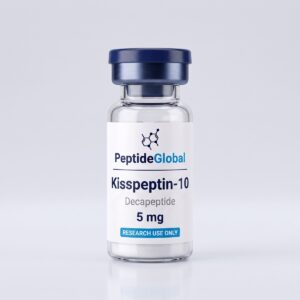
Peptide Global supplies Kisspeptin-10 5 mg as a lyophilised powder in a sealed glass vial, with a batch certificate stating identity, chromatographic purity and the analytical method.
Because it is freeze-dried rather than pre-mixed, the diluent volume you choose sets the working concentration. Storage is at minus twenty degrees, and the reconstituted solution follows the shorter timeline described in how to store research peptides.
Why the gene is called KISS1
The name is not an acronym and the story is genuinely worth knowing, because it explains why the literature can be hard to search.
The gene was identified by a group at Pennsylvania State University working on metastasis suppression, and they named its product metastin. The KISS1 designation came from where the work was done: Hershey, Pennsylvania, home of the chocolate company, and the naming nods to Hershey's Kisses.
The consequence is a compound carrying several unrelated names. Metastin refers to the same precursor, from the cancer literature. Kisspeptin refers to it from the reproductive endocrinology literature. The receptor was GPR54 before its ligand was known, and is KISS1R now. A literature search on one term misses substantial work published under the others.
Two research fields, one molecule
That naming history reflects a real split in the science, and it is unusual.
The first strand is metastasis suppression, which is what the gene was found doing and what metastin was named for. The second is hypothalamic control of reproductive hormone release, which emerged when the receptor's role in gonadotrophin regulation was established, and which is where most current clinical interest sits.
Both strands concern the same molecule at the same receptor. Anyone working with kisspeptin should be aware which literature a given paper belongs to, because the assays, the cell types and the concentration ranges differ considerably between them.
Handling and the amidation
The C-terminal amide is worth a second mention because it is a genuine failure mode rather than a technicality.
Amidation replaces the terminal hydroxyl with an amine group, a difference of one dalton in mass and the entire difference between an active and an inactive molecule. A synthesis that fails to amidate produces free-acid kisspeptin-10, which will look correct on a purity chromatogram, weigh 1303.4 rather than 1302.4, and do nothing at the receptor.
This is precisely why the molecular weight on a certificate of analysis matters more than the purity percentage. A vial can be 99 per cent pure and 100 per cent the wrong molecule. Check the mass against 1302.4, and if a certificate omits it, that certificate is not telling you what you have.
Products described in this guide
Supplied for laboratory research use only. UK delivery is £4.95, free on orders over £100, tracked as standard.
Continue reading
Research use only
Every compound named on this page is supplied by Peptide Global strictly for laboratory research use only. Nothing here is for human or veterinary use. These are not foods, supplements or cosmetics, and they are not intended to diagnose, treat, cure or prevent any disease. Nothing on this page is medical, veterinary or legal advice, and no part of it describes administration to a person or an animal.
Purchasers are responsible for their own compliance with applicable law and with the requirements of their institution or ethics committee. At checkout, purchasers confirm they are a qualified researcher aged 18 or over and that they accept the Research-Use-Only Policy and Terms & Conditions.