Why these two appear together
More people search for CJC-1295 and Ipamorelin as a pair than search for either compound on its own. That is unusual, and it has a specific mechanistic reason rather than being a marketing convention.
The two act at different receptors. They are not variations on a theme and they are not substitutes.
Two receptors, two different jobs
Growth hormone is not released steadily. It comes in pulses, and two separate signals govern those pulses.
CJC-1295 is a GHRH analogue. It works at the growth hormone releasing hormone receptor, which is the signal that tells the pituitary to release and largely determines how large a pulse is.
Ipamorelin works at GHS-R1a, the ghrelin receptor. That pathway does two things the GHRH pathway does not: it triggers release, and it suppresses somatostatin, which is the brake holding release back.
So one input sets amplitude and the other sets timing while lifting the brake. Because the mechanisms are separate rather than overlapping, the literature on pulsatile secretion routinely examines them together, and that is where the pairing in search results comes from.
Which form of CJC-1295 the pairing refers to
Almost always the no-DAC form, and that is worth knowing before ordering.
The no-DAC form has a half-life measured in minutes, which is a closer match to Ipamorelin's short profile. The DAC form persists for days, so pairing it with a compound that clears in minutes produces two very different exposure curves rather than a coordinated one.
Since suppliers list both forms under the name CJC-1295, and PubChem's own synonyms have them labelled the wrong way round, the mass on the certificate is the only reliable check. Around 3368 is no DAC. Around 3647 is DAC. The CJC-1295 guide sets out that distinction in full.
Why Ipamorelin rather than an older secretagogue
Several compounds act at GHS-R1a. Ipamorelin became the usual choice because of what it does not do.
GHRP-6 and GHRP-2 hit the same receptor but also produce measurable cortisol and prolactin effects, and GHRP-6 has a pronounced appetite effect. Ipamorelin is comparatively selective, which makes it a cleaner tool compound when the research question concerns one pathway rather than several at once. That is also why we stock it and not the older secretagogues.
Why we supply them separately
Both are available as premixed blends across this market. We supply them as separate single-compound vials, deliberately.
A fixed-ratio blend cannot tell you which component produced an observed effect. If two compounds are combined at a ratio set by the supplier and something changes, the result is uninterpretable: the effect cannot be attributed to either one, and the ratio cannot be varied to find out. That is a poor basis for research regardless of how convenient it is commercially.
Separate vials let you study each alone, study them together, and vary the ratio. The argument is set out at more length in blends versus single compounds.
How they are supplied
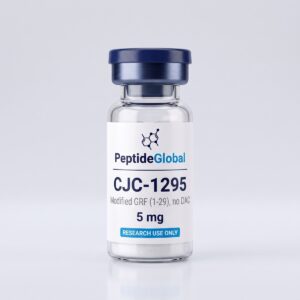
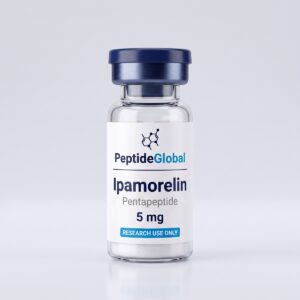
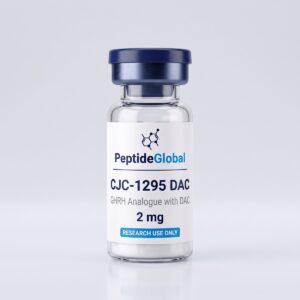
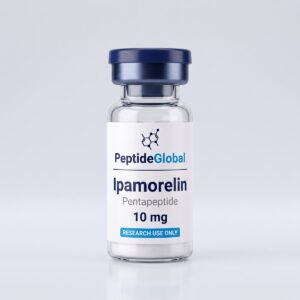
All four as lyophilised vials with batch certificates: CJC-1295 no DAC 5 mg, CJC-1295 with DAC 2 mg, Ipamorelin 5 mg and Ipamorelin 10 mg.
Because all four are freeze-dried, you set the working concentration through the diluent volume, which is what makes ratio control possible in the first place.
Which strengths the pairing usually involves
CJC-1295 without DAC is supplied here at 5 mg and Ipamorelin at 5 mg and 10 mg. The 10 mg Ipamorelin vial is the better cost per milligram of the two, and halves the number of seals broken for a given total mass, which matters over a long series of measurements.
Because both compounds are lyophilised, the working concentration of each is set independently by the diluent volume you choose. That is the practical reason separate vials permit ratio control and a premixed blend does not: with two vials the ratio is a variable you set, with a blend it is a constant somebody else chose.
What the pairing does not establish
It is worth being clear about the limits of what the literature on these two together supports.
That two compounds act at different receptors in the same axis is a mechanistic observation. It does not by itself establish that combining them produces a larger or more useful effect than either alone, and the published work on the combination is considerably thinner than the work on each compound separately.
Most of what circulates about the pairing online is protocol discussion rather than research findings, and a great deal of it concerns human use, which is outside what these products are supplied for. The defensible statement is narrow: the two mechanisms are separate, which makes the combination a coherent thing to study. Whether it does what people claim is a different question, and the honest answer is that the evidence base is small.
The somatostatin point, in more detail
The suppression of somatostatin is the part of Ipamorelin's mechanism most often left out, and it is the part that makes the pairing mechanistically interesting rather than merely additive.
Growth hormone release is governed by two opposing inputs: GHRH pushing release and somatostatin restraining it. A GHRH analogue alone acts against a brake that remains applied. A ghrelin receptor agonist both pushes and reduces the braking signal.
So the two compounds are not simply two accelerators. One is an accelerator and the other is an accelerator plus a partial release of the brake, which is why the combination is studied as more than the sum of two GHRH-type signals. Whether that translates into a measurable difference in any given experimental system is exactly the sort of question the two compounds are bought to answer.
Products described in this guide
Supplied for laboratory research use only. UK delivery is £4.95, free on orders over £100, tracked as standard.
Continue reading
Research use only
Every compound named on this page is supplied by Peptide Global strictly for laboratory research use only. Nothing here is for human or veterinary use. These are not foods, supplements or cosmetics, and they are not intended to diagnose, treat, cure or prevent any disease. Nothing on this page is medical, veterinary or legal advice, and no part of it describes administration to a person or an animal.
Purchasers are responsible for their own compliance with applicable law and with the requirements of their institution or ethics committee. At checkout, purchasers confirm they are a qualified researcher aged 18 or over and that they accept the Research-Use-Only Policy and Terms & Conditions.