Chemical identity
| Designation | DSIP (delta sleep-inducing peptide) |
|---|---|
| CAS number | 62568-57-4 |
| Molecular formula | C35H48N10O15 |
| Molecular weight | 848.8 g/mol |
| Amino-acid sequence | Trp-Ala-Gly-Gly-Asp-Ala-Ser-Gly-Glu |
| Cartridge strength | 5 mg per vial |
| Concentration | Set on reconstitution |
| Presentation | |
| Storage | 2–8 °C, protect from light, do not freeze |
Verified 8 Sep 2026 against PubChem CID 68816. Sequence-derived mass 848.82 against PubChem 848.8. Naturally occurring rather than a synthetic analogue, so the material is a copy of an endogenous sequence.
Identifiers verified against PubChem in both directions — name to compound record, then each CAS number back again — and, where the sequence is of standard residues, cross-checked by recomputing the molecular weight from the sequence. No purity, HPLC or certificate-of-analysis figure is stated, because no supplier data supports one.
What is DSIP?
DSIP stands for delta sleep-inducing peptide. It is a chain of nine amino acids, sequence Trp-Ala-Gly-Gly-Asp-Ala-Ser-Gly-Glu, molecular weight 848.8.
Unlike most of this catalogue it is a naturally occurring peptide rather than a designed analogue, so the synthetic material is a copy of a sequence that already exists rather than an engineered modification of one. It was isolated in the 1970s from the cerebral venous blood of rabbits.
It holds no marketing authorisation in any territory.
What the name does and does not tell you
The name is the most misleading thing about this compound, and it is worth addressing directly.
DSIP was named for the experimental context in which it was found: work on delta-wave sleep in rabbits. A name assigned at the point of discovery describes what the researchers were looking at, not what the molecule was subsequently shown to do. Plenty of biology carries names from a first observation that later turned out to be a minor part of the picture, and this is one of them.
The literature since has examined the peptide across a range of endpoints, and it is more mixed and more modest than the name implies. Anyone taking the name as a summary of the evidence is reading a label rather than the papers.
What is studied in vitro
Receptor identification remains an open strand, which is unusual for a peptide this long known. No single receptor has been established as its primary target in the way that KISS1R belongs to kisspeptin or the GHRH receptor to sermorelin, so a portion of the published work is still concerned with what it binds.
Stability and degradation work is a second strand. A nine-residue peptide with no non-natural residues and no modifications is a straightforward substrate for plasma peptidases, so half-life in various media is a routine measurement.
Because the sequence is short and entirely standard residues, DSIP is also used as a reference peptide in method development, where a well-characterised molecule of known mass is needed to validate an assay rather than to answer a biological question.
Regulatory position
No marketing authorisation anywhere. DSIP is centrally active, and whether a centrally active peptide falls within the scope of the Psychoactive Substances Act 2016 is a question we have not seen settled authoritatively either way. It sits alongside the medicines position rather than replacing it, and we state it because it is material to anyone holding or supplying the compound.
How it is supplied
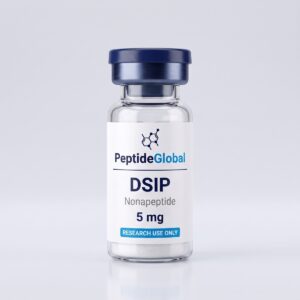
Peptide Global supplies DSIP 5 mg as a lyophilised powder in a sealed vial with a batch certificate of analysis. Storage is at minus twenty degrees and reconstitution follows the standard route for freeze-dried material.
Why the receptor question is still open
For a peptide isolated half a century ago, the absence of an established primary receptor is unusual and worth understanding.
Most peptides in this catalogue have a clearly identified target. Sermorelin and CJC-1295 act at the GHRH receptor, Ipamorelin at GHS-R1a, kisspeptin at KISS1R. Each of those pairings gives the compound a defined pharmacology and a standard set of assays.
DSIP has no equivalent. Reported effects have not converged on a single binding site, and a portion of the published literature is still concerned with identifying what it binds rather than with characterising what happens after binding. That makes it a harder compound to work with, since without a known receptor there is no obvious primary assay, and it also makes mechanistic claims about it weaker than the volume of published papers might suggest.
Working with a fully natural sequence
DSIP contains only standard L-amino acids, no non-natural residues, no D-isomers and no terminal modifications. That distinguishes it from most of this catalogue, where the modifications are the point.
The practical consequence is straightforward: a completely natural nine-residue sequence is an unprotected substrate for plasma and tissue peptidases, so it degrades readily. Compounds like CJC-1295 exist precisely because their designers were trying to avoid that. DSIP has none of those defences because nothing was designed into it.
For laboratory work that is often a feature rather than a drawback. A rapidly cleared, unmodified sequence of known mass is useful as a reference peptide in method development and in degradation studies, where the object is to watch something break down in a controlled way.
Handling and storage
Supplied lyophilised and stored at minus twenty degrees, protected from light. The freeze-dried powder is stable considerably longer than any solution made from it, which is the argument for reconstituting only what is needed.
Bring the vial to room temperature before opening, add diluent down the inside wall, swirl gently and do not shake. Given the sequence has no protective modifications, a reconstituted solution should be treated as short-lived and kept cold.
Products described in this guide
Supplied for laboratory research use only. UK delivery is £4.95, free on orders over £100, tracked as standard.
Continue reading
Research use only
Every compound named on this page is supplied by Peptide Global strictly for laboratory research use only. Nothing here is for human or veterinary use. These are not foods, supplements or cosmetics, and they are not intended to diagnose, treat, cure or prevent any disease. Nothing on this page is medical, veterinary or legal advice, and no part of it describes administration to a person or an animal.
Purchasers are responsible for their own compliance with applicable law and with the requirements of their institution or ethics committee. At checkout, purchasers confirm they are a qualified researcher aged 18 or over and that they accept the Research-Use-Only Policy and Terms & Conditions.