Chemical identity
| Designation | Epithalon (Epitalon, AEDG) |
|---|---|
| CAS number | 307297-39-8 |
| Molecular formula | C14H22N4O9 |
| Molecular weight | 390.35 g/mol |
| Amino-acid sequence | Ala-Glu-Asp-Gly |
| Cartridge strength | 10 mg per vial |
| Concentration | Set on reconstitution |
| Presentation | |
| Storage | 2–8 °C, protect from light, do not freeze |
Verified 8 Sep 2026 against PubChem CID 219042. Sequence-derived mass 390.35 matched PubChem exactly. Sold under three names: Epithalon and Epitalon are transliteration variants and AEDG is the single-letter sequence code.
Identifiers verified against PubChem in both directions — name to compound record, then each CAS number back again — and, where the sequence is of standard residues, cross-checked by recomputing the molecular weight from the sequence. No purity, HPLC or certificate-of-analysis figure is stated, because no supplier data supports one.
What is Epithalon?
Epithalon is a synthetic peptide of four amino acids, sequence Ala-Glu-Asp-Gly, molecular weight 390.35. Four residues makes it among the shortest sequences sold as a research peptide, and short enough that the term peptide is doing real work: this is a small molecule by the standards of the rest of this catalogue.
It was synthesised at the St Petersburg Institute of Bioregulation and Gerontology as a defined analogue of epithalamin, an extract of pineal tissue. Replacing an extract with a single synthesised sequence is the point: an extract is a mixture whose composition varies, whereas a tetrapeptide is one molecule that can be made to specification and verified.
It holds no marketing authorisation in any territory.
Epitalon or Epithalon, and AEDG
Three names, one molecule. Epithalon and Epitalon are transliteration variants of the same Russian name and both are in common use, including by suppliers who use them interchangeably within a single catalogue. AEDG is the single-letter amino acid code for the sequence, and is the least ambiguous of the three.
If you are searching the literature, all three are worth trying, since papers split across the spellings. The molecular weight of 390.35 is the reliable identifier.
Why four residues changes the handling
Molecular weight has practical consequences that a milligram figure on a label conceals.
At 390.35, Epithalon is roughly a quarter the mass of BPC-157. A 10 mg vial of Epithalon therefore contains around four times as many molecules as a 10 mg vial of BPC-157. Any work prepared on a molar basis rather than by weight needs that arithmetic done explicitly, and it is the most common source of error when moving between compounds of very different size.
Short peptides also behave differently in the vial. Fewer peptide bonds means fewer sites for enzymatic cleavage, which tends to help stability. Against that, small peptides can be lost to adsorption onto glass and plastic surfaces at low concentrations, so a very dilute preparation may contain less than the arithmetic suggests.
What is studied in vitro
Telomerase activity in cultured cells is the strand the compound is best known for, typically assayed by telomeric repeat amplification protocol in fibroblast or lymphocyte cultures across a concentration range.
Markers of cellular senescence form a related strand, with the usual readouts being senescence-associated beta-galactosidase staining, proliferative capacity across passages, and expression of cell cycle regulators.
It is worth being straight about the state of this literature. It is small, a large proportion of it originates from the institute that developed the compound, and independent replication outside that group is limited. Anyone citing it should read the primary sources rather than secondary summaries, several of which overstate what the original papers claim.
How it is supplied
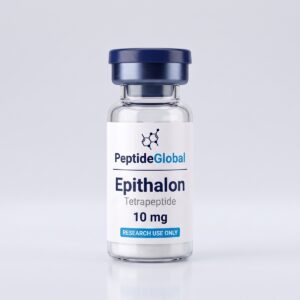
Peptide Global supplies Epithalon 10 mg as a lyophilised powder in a sealed vial with a batch certificate of analysis.
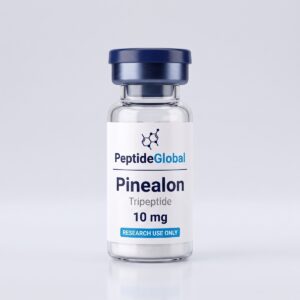
The related tetrapeptide work from the same institute includes Pinealon, a tripeptide, and the two are often studied alongside each other. Storage and reconstitution follow the standard route for lyophilised material.
From tissue extract to defined sequence
Epithalon exists because of a problem with the thing that preceded it.
Epithalamin was a preparation made from pineal tissue, and like any tissue extract it was a mixture rather than a compound. Its composition varied between batches, it could not be specified precisely, and any result obtained with it was difficult to attribute to a particular constituent. Those are serious limitations for research, and the same limitations apply to every extract-based preparation.
Synthesising a defined tetrapeptide instead addresses all three. One molecule, one molecular weight, a formula that can be verified against an independent database, and a purity figure that means something. That shift from extract to defined sequence is what the St Petersburg programme was for, and Epithalon is its best-known output.
Whether the tetrapeptide accounts for what the extract was reported to do is a separate question, and one the literature does not settle.
Epithalon and Pinealon
The two most widely circulated peptides from that programme are usually encountered together, and the comparison is instructive.
Epithalon is four residues, Ala-Glu-Asp-Gly, at 390.35. Pinealon is three, Glu-Asp-Arg, at 418.4. Pinealon is the shorter chain yet the heavier molecule, because arginine is the largest of the standard residues at 156 daltons and glycine the smallest at 57.
That inversion is a useful reminder that chain length and molecular weight are different measurements. Comparing peptides on residue count alone will mislead you about how much material a given mass represents, and it is the sort of error that a specification table stating both figures prevents.
Handling a tetrapeptide
Short sequences are generally more robust in storage than long ones, since there are fewer peptide bonds available for enzymatic or chemical cleavage. A sealed lyophilised vial at minus twenty degrees will keep well.
The offsetting risk is loss to surfaces. Small peptides adsorb onto glass and plastic, and at low working concentrations that can remove a meaningful fraction of what was dissolved. Where a dilute preparation is required, the usual mitigations are low-binding labware and preparing fresh rather than storing dilute solutions.
Products described in this guide
Supplied for laboratory research use only. UK delivery is £4.95, free on orders over £100, tracked as standard.
Continue reading
Research use only
Every compound named on this page is supplied by Peptide Global strictly for laboratory research use only. Nothing here is for human or veterinary use. These are not foods, supplements or cosmetics, and they are not intended to diagnose, treat, cure or prevent any disease. Nothing on this page is medical, veterinary or legal advice, and no part of it describes administration to a person or an animal.
Purchasers are responsible for their own compliance with applicable law and with the requirements of their institution or ethics committee. At checkout, purchasers confirm they are a qualified researcher aged 18 or over and that they accept the Research-Use-Only Policy and Terms & Conditions.