Chemical identity
| Designation | Pinealon |
|---|---|
| CAS number | 175175-23-2 |
| Molecular formula | C15H26N6O8 |
| Molecular weight | 418.4 g/mol |
| Amino-acid sequence | Glu-Asp-Arg |
| Cartridge strength | 10 mg per vial |
| Concentration | Set on reconstitution |
| Presentation | |
| Storage | 2–8 °C, protect from light, do not freeze |
Verified 8 Sep 2026 against PubChem CID 10273502. Sequence-derived mass 418.41 against PubChem 418.4. At three residues this is among the smallest molecules in the catalogue, so mass-based and molar-based comparisons against longer peptides diverge sharply.
Identifiers verified against PubChem in both directions — name to compound record, then each CAS number back again — and, where the sequence is of standard residues, cross-checked by recomputing the molecular weight from the sequence. No purity, HPLC or certificate-of-analysis figure is stated, because no supplier data supports one.
What is Pinealon?
Pinealon is a synthetic tripeptide: three amino acids, Glu-Asp-Arg, molecular weight 418.4. Three residues is close to the floor of what can meaningfully be called a peptide, and puts it in the same size class as GHK, the copper-binding tripeptide.
It comes from the St Petersburg Institute of Bioregulation and Gerontology, the same programme on short regulatory peptides that produced Epithalon. The premise of that programme was that very short defined sequences could substitute for tissue extracts, and Pinealon and Epithalon are its two most widely circulated outputs.
It holds no marketing authorisation in any territory.
What three residues means in practice
At 418.4 Da, Pinealon is roughly a third the mass of BPC-157 and about a ninth the mass of CJC-1295. A 10 mg vial therefore contains around three and a half times as many molecules as a 10 mg vial of BPC-157, and roughly nine times as many as 10 mg of a 29-residue peptide would.
That is the single most useful thing to know before working with it. Milligram figures on labels invite comparison by weight, and weight is the wrong axis when molecular sizes differ this much. Anything prepared on a molar basis needs the conversion done from the actual molecular weight rather than assumed from the strength.
Handling follows from the size too. Very short peptides present few cleavage sites, which helps stability, but they are more prone to loss by adsorption onto container surfaces at low concentration. A dilute preparation left standing in glass may deliver less than the arithmetic predicts.
What is studied in vitro
Neuronal cell culture is the dominant strand, typically using established neuronal or neuroblastoma lines, with viability and oxidative stress readouts after treatment across a concentration range. Protection assays under induced stress, such as hypoxia or hydrogen peroxide challenge, recur throughout the published work.
Because the sequence is charged at both ends and carries an arginine, membrane interaction and uptake are a second strand: whether and how a small, highly polar tripeptide crosses a cell membrane is not obvious, and is a legitimate question in its own right.
As with Epithalon, the literature should be characterised accurately. It is small, concentrated in the output of one institute, and thin on independent replication. That is a description of the evidence base, not a criticism of the compound, but it should inform how strongly any claim resting on it is stated.
How it is supplied
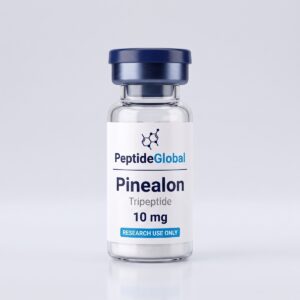
Peptide Global supplies Pinealon 10 mg as a lyophilised powder in a sealed vial with a batch certificate of analysis stating identity, purity and method.
Researchers working across the short-peptide range usually hold it alongside Epithalon, and both reconstitute the same way. See bacteriostatic water and peptide stability for the handling detail.
The short-peptide programme it came from
Pinealon is one output of a research programme rather than a standalone compound, and the programme's premise explains the shape of the literature around it.
The St Petersburg Institute of Bioregulation and Gerontology pursued the idea that very short defined sequences, of three or four residues, could carry regulatory information and substitute for the tissue extracts then in use. Epithalon came from the same programme, and a number of related tripeptides and tetrapeptides were produced alongside them.
Two things follow. The compounds tend to be studied as a family rather than individually, so papers frequently cover several at once. And the literature is concentrated in the output of one institute, which means independent replication is limited and any claim resting on it should be stated with that in mind.
A worked comparison, since mass misleads
The molecular weight difference between Pinealon and the longer peptides in this catalogue is large enough to change experimental design, so it is worth working through.
Pinealon is 418.4 g/mol. BPC-157 is 1419.5. CJC-1295 without DAC is 3367.9.
Take 10 mg of each. In molar terms that is roughly 23.9 micromoles of Pinealon, 7.0 micromoles of BPC-157, and 3.0 micromoles of CJC-1295. The same mass of material delivers about eight times as many Pinealon molecules as CJC-1295 molecules.
Anything prepared to a target molar concentration therefore needs the conversion done from the actual molecular weight, not estimated from the milligram figure on the label. Comparing two compounds at the same mass concentration is comparing them at very different molar concentrations, and that is one of the more common sources of uninterpretable results when moving between compounds of different size.
Handling a tripeptide
Three residues means two peptide bonds, so there is very little for a peptidase to work on and the lyophilised powder is robust in storage at minus twenty degrees.
Surface adsorption is the offsetting concern and it is more pronounced the smaller and more charged the molecule. Pinealon carries acidic side chains at two positions and a basic arginine at the third, so it is highly polar. At low concentrations a meaningful fraction can be lost to container walls, which argues for low-binding labware and preparing dilute solutions fresh rather than storing them.
Products described in this guide
Supplied for laboratory research use only. UK delivery is £4.95, free on orders over £100, tracked as standard.
Continue reading
Research use only
Every compound named on this page is supplied by Peptide Global strictly for laboratory research use only. Nothing here is for human or veterinary use. These are not foods, supplements or cosmetics, and they are not intended to diagnose, treat, cure or prevent any disease. Nothing on this page is medical, veterinary or legal advice, and no part of it describes administration to a person or an animal.
Purchasers are responsible for their own compliance with applicable law and with the requirements of their institution or ethics committee. At checkout, purchasers confirm they are a qualified researcher aged 18 or over and that they accept the Research-Use-Only Policy and Terms & Conditions.