What they actually share
Semax and Selank are constantly paired, and for once the pairing is well founded — but not for the reason usually given. They are not variants of one another and their parent sequences are unrelated. What they share is a design pattern, an institution and a history.
Both are heptapeptides: seven residues each. Both consist of a short natural fragment with a proline-glycine-proline sequence attached at the carboxyl end. Both were developed at the Institute of Molecular Genetics of the Russian Academy of Sciences, both have been used clinically in Russia, and neither holds a UK marketing authorisation. Both are supplied here in identical cartridges.
That is a real family resemblance. It is a resemblance of engineering rather than of pharmacology, and the distinction is the point of this page.
Side by side
| Semax | Selank | |
|---|---|---|
| Parent fragment | ACTH(4–10) | Tuftsin, a tetrapeptide |
| Parent's own role | Pituitary hormone (ACTH) | Immunoglobulin G fragment |
| Total length | 7 residues | 7 residues |
| Stabilising tail | Pro-Gly-Pro | Pro-Gly-Pro |
| Parent hormone activity retained | No corticotropic activity reported | Not applicable — parent is not a hormone |
| Main in-vitro strand | Neurotrophic signalling, BDNF | GABAergic and serotonergic systems |
| Cartridge | 20 mg in 3 ml, 6.67 mg/ml | 20 mg in 3 ml, 6.67 mg/ml |
The shared tail is the design, not the compound
The Pro-Gly-Pro extension both molecules carry is doing the same job in each, and it is a job entirely separate from what either compound does.
Very short peptides are cleaved rapidly. A bare tetrapeptide such as tuftsin, or a bare seven-residue fragment such as ACTH(4–10), has a very short life in any biological preparation, which makes it difficult to use as a research tool regardless of its properties. A proline-rich terminus is markedly harder for peptidases to attack, so attaching one extends the molecule's usable life without altering what it recognises.
So the shared feature is a solution to a shared problem — both parent fragments were too short-lived to work with — and not evidence of shared activity. This is worth internalising because the pattern recurs: capping a terminus in tesamorelin, cyclising the chain in Melanotan II, and adding a fatty acid in tirzepatide are all the same class of decision. Durability engineering and pharmacology are separate axes, and a shared answer on one says nothing about the other.
The parents could hardly be less alike
Semax descends from adrenocorticotropic hormone — a pituitary hormone whose endocrine job is to stimulate corticosteroid release. The 4–10 fragment it uses is the portion associated with effects on the nervous system rather than the endocrine action, and Semax is reported as lacking corticotropic activity because the residues that action requires are not all present in the fragment. It is an ACTH derivative that is not an ACTH agonist.
Selank descends from tuftsin, a four-residue peptide released from the heavy chain of immunoglobulin G and originally characterised for its effects on phagocytic cells. Its parent is not a hormone at all, so there is no equivalent question about retained hormonal activity.
The consequence for interpretation is real. Semax's literature centres on neurotrophic signalling, with brain-derived neurotrophic factor recurring throughout. Selank's centres on neurotransmitter systems — GABAergic and serotonergic — with an additional specific claim about inhibiting enkephalin degradation, and a separate immunological strand following from tuftsin. Overlapping fields, different mechanisms, different controls.
One design caution follows from Selank's parentage specifically: in a mixed or immune-competent preparation, an observation may have an immunological route as well as a neural one, and an experiment addressing a neural question needs a design that can tell them apart.
The cartridges are identical
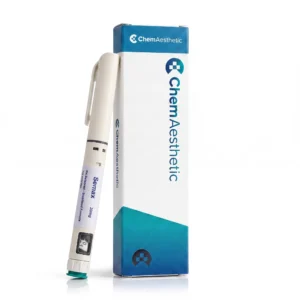
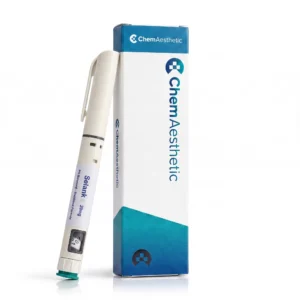
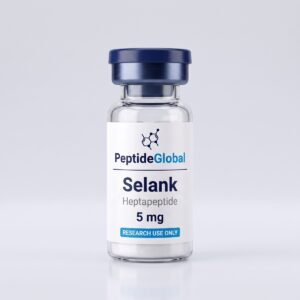
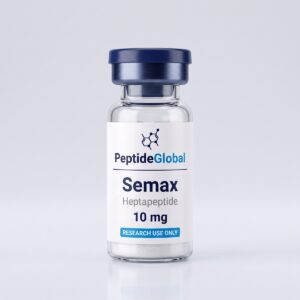
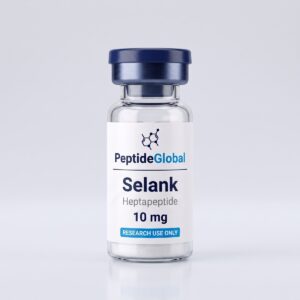
The Semax Pen 20 mg and the Selank Pen 20 mg hold the same mass at the same concentration in the same volume: 20 mg in a sealed 3 ml cartridge at 6.67 mg/ml, pre-mixed, with no reconstitution step.
That is genuinely convenient for anyone running the two side by side, since it means volume dispensed converts to mass identically for both and no separate arithmetic is needed. Storage is the same too: 2–8 °C, protected from light, not frozen, for as long as the cartridge is held. See how the pen works.
Common questions
Are Semax and Selank the same kind of peptide?
They share a design but not a lineage. Both are seven-residue peptides consisting of a short natural fragment plus a Pro-Gly-Pro tail, both were developed at the same Russian institute, and both are supplied in identical cartridges — but their parent sequences are unrelated.
What is the Pro-Gly-Pro tail for?
Durability. Both parent fragments are too short-lived to work with, and a proline-rich terminus is much harder for peptidases to attack. The tail extends the molecule's usable life without changing what it recognises, so a shared tail says nothing about shared activity.
Which parent molecule does each come from?
Semax is built on ACTH(4–10), a fragment of adrenocorticotropic hormone. Selank is built on tuftsin, a four-residue peptide released from the heavy chain of immunoglobulin G. One parent is a pituitary hormone, the other an antibody fragment.
Does Semax act like ACTH?
No. It is reported as lacking corticotropic activity, because not all the residues ACTH needs for its endocrine action are present in the 4–10 fragment. Selank raises no equivalent issue, since its parent is not a hormone.
Do the two pens differ?
No. Both hold 20 mg in a sealed 3 ml cartridge at 6.67 mg/ml, pre-mixed, with identical storage conditions — convenient when running the two side by side, since volume converts to mass the same way for each.
Products described in this guide
Supplied for laboratory research use only. UK delivery is £4.95, free on orders over £100, tracked as standard.
Continue reading
Research use only
Every compound named on this page is supplied by Peptide Global strictly for laboratory research use only. Nothing here is for human or veterinary use. These are not foods, supplements or cosmetics, and they are not intended to diagnose, treat, cure or prevent any disease. Nothing on this page is medical, veterinary or legal advice, and no part of it describes administration to a person or an animal.
Purchasers are responsible for their own compliance with applicable law and with the requirements of their institution or ethics committee. At checkout, purchasers confirm they are a qualified researcher aged 18 or over and that they accept the Research-Use-Only Policy and Terms & Conditions.