What "peptide bioregulator" means
"Peptide bioregulator" is a name for a family of very short peptides, usually two to four amino acids long, developed at the St Petersburg Institute of Bioregulation and Gerontology. They are also called bioregulator peptides, or Khavinson peptides after Vladimir Khavinson, whose group produced them. The best known are Epithalon and Pinealon.
The name describes the programme's hypothesis rather than an established mechanism. The idea was that very short defined sequences could carry regulatory information and stand in for tissue extracts that were then in use. That idea is the reason these peptides exist. Whether it holds is a separate matter, and the honest position on the evidence is set out further down.
One practical caution about the term. Products sold under the bioregulator name in the wider market are not all the same kind of thing. Some are defined synthetic sequences like the two covered here; others are supplements derived from animal tissue. A tissue-derived preparation is a mixture whose composition varies, and it is not interchangeable with a single synthesised peptide of known sequence and mass.
From tissue extract to defined sequence
The programme began with extracts. Epithalamin, for example, was a preparation from pineal tissue. Like any extract it was a mixture: its composition varied between batches, it could not be specified precisely, and any result obtained with it was difficult to attribute to one constituent.
Synthesising a short defined peptide addresses all three problems. One molecule, one molecular weight, a sequence that can be checked against an independent database. Epithalon was made as a defined analogue of epithalamin, and Pinealon came from the same line of work. That move from extract to sequence is the programme's lasting contribution whatever one concludes about the regulatory hypothesis.
Epithalon and Pinealon side by side
| Epithalon | Pinealon | |
|---|---|---|
| Also written | Epitalon, AEDG | EDR |
| Sequence | Ala-Glu-Asp-Gly | Glu-Asp-Arg |
| Residues | 4 | 3 |
| Molecular weight | 390.35 g/mol | 418.4 g/mol |
| Main in-vitro strand | Telomerase activity, senescence markers | Neuronal cell culture, oxidative stress |
| Supplied here as | 10 mg lyophilised vial | 10 mg lyophilised vial |
| Storage as supplied | −20 °C, protect from light | −20 °C, protect from light |
| Marketing authorisation | None anywhere | None anywhere |
Pinealon is the shorter chain but the heavier molecule. Arginine is the largest standard amino acid and glycine the smallest, so three residues ending in arginine outweigh four ending in glycine. It is a useful reminder that chain length and molecular weight are different measurements.
What each is studied for
Epithalon is best known for work on telomerase activity in cultured cells, typically fibroblast or lymphocyte cultures, together with markers of cellular senescence such as senescence-associated beta-galactosidase staining and proliferative capacity across passages.
Pinealon appears mainly in neuronal cell culture, using established neuronal or neuroblastoma lines, with viability and oxidative stress readouts under induced stress such as hypoxia or hydrogen peroxide challenge. Because it is small, highly polar and carries an arginine, how it crosses a cell membrane is a research question in its own right.
The two are often studied together, and papers from the programme frequently cover several of its short peptides at once.
The state of the evidence
This is the part most descriptions of bioregulators leave out. The literature on these peptides is small, a large proportion of it comes from the institute that developed them, and independent replication outside that group is limited. Several secondary summaries overstate what the primary papers report.
That is a description of the evidence base rather than a verdict on the compounds, and it argues for reading the primary sources directly and stating any claim that rests on them with matching caution. It also makes independent work on these peptides more valuable than usual, because so little of it exists.
Mass is the wrong way to compare them
Both vials hold 10 mg, but milligrams say little about how many molecules are present. 10 mg of Epithalon is about 25.6 micromoles; 10 mg of Pinealon is about 23.9 micromoles. Those are close to each other, but both are far more than the same mass of a longer peptide: 10 mg of BPC-157, at 1419.5 g/mol, is about 7.0 micromoles.
So when work moves between a bioregulator and a longer peptide, a solution prepared to the same mass concentration is at a very different molar concentration. Any comparison on a molar basis needs the conversion done from the actual molecular weights.
Handling very short peptides
With only two or three peptide bonds, these sequences offer little for a peptidase to work on, and the lyophilised powder keeps well sealed at −20 °C. The offsetting concern is loss to surfaces: small, charged peptides adsorb onto glass and plastic, and at low working concentrations a meaningful fraction can be lost to container walls. Low-binding labware and preparing dilute solutions fresh are the usual answers.
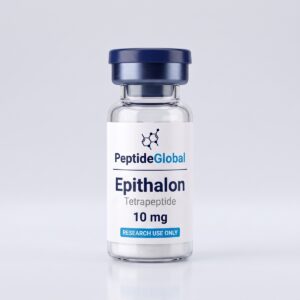
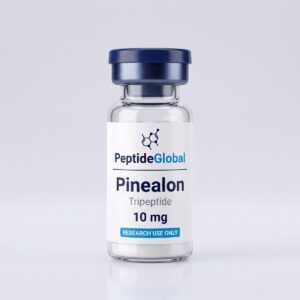
Both are supplied as lyophilised powder and need reconstituting before use. Which diluent to use, and how the volume added sets the concentration, is covered in bacteriostatic water vs sterile water vs acetic acid. The vials are Epithalon 10 mg and Pinealon 10 mg.
Common questions
What are peptide bioregulators?
A family of very short synthetic peptides, usually two to four residues, developed at the St Petersburg Institute of Bioregulation and Gerontology as defined replacements for tissue extracts. Epithalon and Pinealon are the best known.
What are Khavinson peptides?
Another name for the same family, after Vladimir Khavinson, whose group at the St Petersburg institute developed them.
What is the difference between Epithalon and Pinealon?
Epithalon is a tetrapeptide, Ala-Glu-Asp-Gly, at 390.35 g/mol, studied mainly for telomerase activity and senescence markers. Pinealon is a tripeptide, Glu-Asp-Arg, at 418.4 g/mol, studied mainly in neuronal cell culture. Both come from the same programme.
Is Epitalon the same as Epithalon?
Yes. They are transliteration variants of the same Russian name, and AEDG is the single-letter code for its sequence. The molecular weight, 390.35 g/mol, is the reliable identifier.
Are bioregulator supplements the same as these peptides?
Not necessarily. Some products sold as bioregulators are tissue-derived preparations, which are mixtures of variable composition. Epithalon and Pinealon as supplied here are single synthetic sequences of stated mass.
Are peptide bioregulators legal in the UK?
Neither Epithalon nor Pinealon holds a marketing authorisation anywhere. Both are supplied for in-vitro laboratory research, which sits outside the medicines framework. Nothing here is legal advice.
Products described in this guide
Supplied for laboratory research use only. UK delivery is £4.95, free on orders over £100, tracked as standard.
Continue reading
Research use only
Every compound named on this page is supplied by Peptide Global strictly for laboratory research use only. Nothing here is for human or veterinary use. These are not foods, supplements or cosmetics, and they are not intended to diagnose, treat, cure or prevent any disease. Nothing on this page is medical, veterinary or legal advice, and no part of it describes administration to a person or an animal.
Purchasers are responsible for their own compliance with applicable law and with the requirements of their institution or ethics committee. At checkout, purchasers confirm they are a qualified researcher aged 18 or over and that they accept the Research-Use-Only Policy and Terms & Conditions.