Laboratories working on copper delivery via a tripeptide carrier, and on the GHK sequence in matrix and fibroblast models.
Regulated as a cosmetic ingredient in topical form under the name Copper Tripeptide-1. Never authorised as a medicine in any territory. Supplied here as a lyophilised research reagent.
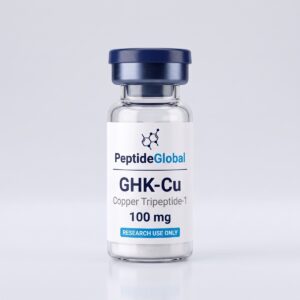
GHK-Cu 50mg Vial | Copper Tripeptide-1
Held and dispatched from the UK — cold chain from storage to door Held & dispatched from the UK
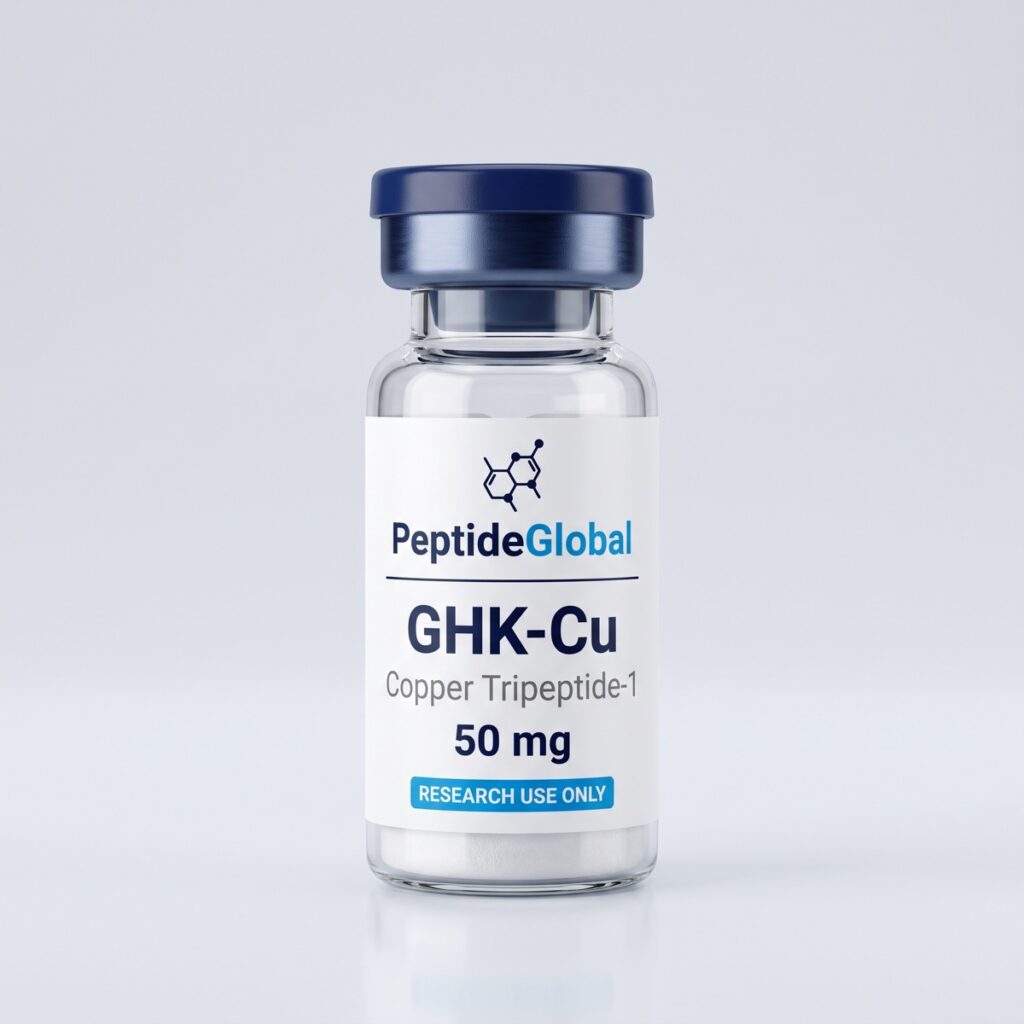
50 mg per vial GHK-Cu (copper tripeptide-1) supplied as lyophilised powder in a sealed vial. For laboratory research use only.
- Lyophilised powder, reconstitute before use
- Sealed pharmaceutical pack
- UK delivery £4.95, free over £100
Bulk order & save
100 in stock · ready to dispatch
Same-day dispatch on orders placed before 2pm, Monday to Friday.
Product description
GHK-Cu is glycyl-L-histidyl-L-lysine bound to copper(II), supplied here as 50 mg of lyophilised powder in a sealed vial for reconstitution in the laboratory. No pre-mixed solution and no fixed concentration, so the working strength is yours to set.
What is GHK-Cu?
GHK is a tripeptide of just three residues, glycine, histidine and lysine. On its own it is an unremarkable small molecule at 340.4 g/mol. Its interest comes from the histidine and lysine side chains, which together form a binding site with unusually high affinity for copper(II).
The distinction that matters when ordering is between GHK and GHK-Cu. The first is the free tripeptide, CAS 49557-75-7. The second is the copper complex, CAS 89030-95-5, a chemically distinct entity with a different molecular formula and mass. This product is the copper complex, and the certificate of analysis identifies it as such.
Why the sequence is studied
GHK was first isolated from human plasma in 1973, where it occurs naturally. Reported plasma concentrations fall with age, from roughly 200 ng/ml in early adulthood to around 80 ng/ml by the sixth decade. That observation is what drew attention to the sequence, and copper itself is a required cofactor for lysyl oxidase, the enzyme that cross-links collagen, and for superoxide dismutase.
Published laboratory work on the tripeptide covers copper transport, matrix protein expression in fibroblast culture, and gene expression profiling. Campbell and colleagues reported broad transcriptional effects in Genome Medicine in 2012. The topical literature is considerably larger than the parenteral literature, and there are no completed randomised human trials of injectable GHK-Cu.
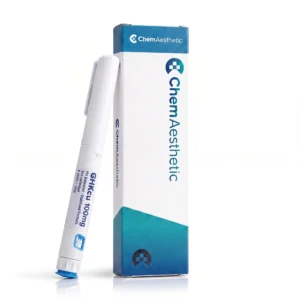
Vial or pre-mixed pen
A lyophilised vial and a pre-mixed cartridge are not interchangeable formats. Lyophilised powder is stable for far longer, ships without a fixed concentration, and lets the laboratory choose its own diluent and working strength. A pre-mixed pen removes the reconstitution step but locks the concentration at manufacture. For method development where concentration is a variable, the vial is the appropriate format.
Is topical GHK-Cu the same as injectable GHK-Cu?
No, and the distinction matters more than any other point on this page.
Topical GHK-Cu has been a mainstream cosmetic ingredient for over thirty years. On an ingredients list it appears under its INCI name, Copper Tripeptide-1, and it sits in serums and creams sold openly on the high street. That use is well established and the literature behind it is comparatively large.
Injectable GHK-Cu is an entirely different proposition. There are no completed randomised human trials of injectable GHK-Cu. Literature describing topical application does not transfer, because route of administration changes distribution, concentration at the target and everything downstream.
This product is a lyophilised research reagent. It is not a cosmetic, it is not formulated as one, and the cosmetic literature should not be read across to it. If a supplier cites decades of topical evidence while selling you a vial, they are citing the wrong evidence.
Price per milligram
This vial is £26.99 for 50 mg, which is £0.54 per milligram. Comparing suppliers on price per milligram rather than headline price is the only like-for-like comparison, because vial strengths are not standardised across this market.
Does it come with a certificate of analysis?
Every batch is supplied with a certificate of analysis stating the batch reference, identity confirmation, chromatographic purity against specification, and the analytical method used. Purity is determined by reverse-phase HPLC with mass spectrometric identity confirmation. The certificate is specific to the batch you receive rather than a generic sample document, and states the laboratory that performed the work.
How is it reconstituted?
Vials arrive as a lyophilised cake under vacuum. Store sealed at −20 °C, protected from light. Allow the vial to reach room temperature before breaking the seal, which prevents condensation drawing moisture into the powder.
Reconstitute with bacteriostatic water added slowly down the vial wall rather than directly onto the cake. Swirl gently until dissolved; do not shake, as agitation shears peptide chains. GHK-Cu in solution carries a characteristic blue tint from the copper complex.
Once in solution, GHK-Cu should be kept refrigerated at 2 to 8 °C and protected from light. Avoid repeated freeze-thaw cycles, which degrade peptides faster than steady refrigeration. Reconstituted material is not indefinitely stable and working solutions are best prepared in the volumes actually needed.
Cold chain and UK dispatch
Held at −20 °C from arrival through to dispatch. Orders ship in insulated packaging with a cold pack, tracked, so material spends as little time as possible at ambient temperature. Short transit excursions are normal for lyophilised peptides and do not compromise a sealed vial, but the powder should go back into cold storage on arrival.
Supplied strictly for laboratory research use only. Not for human or veterinary use, and not for diagnostic or therapeutic application. Purchasers must be 18 or over and are responsible for compliance with the rules applying to them.
Specifications
| Compound | GHK-Cu (copper tripeptide-1) |
|---|---|
| CAS | 89030-95-5 |
| Molecular formula | C14H24CuN6O4 |
| Molecular weight | 403.9 g/mol |
| Sequence | Gly-His-Lys, copper(II) complex |
| Form | Lyophilised powder |
| Strength | 50 mg per vial |
| Presentation | Sealed glass vial, flip-off cap |
| Purity | ≥98% by RP-HPLC |
| Storage | −20 °C, protect from light |
| SKU | PG-GHKCU-VIAL-50 |
Storage and handling
| Reconstitution | Required. Reconstitute with bacteriostatic water before use. |
|---|---|
| Sealed, as supplied | −20 °C, protect from light. Do not freeze. |
| Once in use | Return to refrigerated storage between use. Keep the cartridge upright. |
| Before dispensing | Allow the cartridge to reach room temperature. Do not shake. |
Frequently asked questions
What is the Copper Tripeptide-1 pen?
The Copper Tripeptide-1 pen is GHK-Cu (copper tripeptide-1) supplied as 50 mg of lyophilised powder in a sealed vial, for reconstitution in the laboratory at whatever concentration the work requires. It is supplied for laboratory research use only.
How much is the GHK-Cu 50mg Vial?
GHK-Cu 50mg Vial is £26.99. UK delivery is £4.95, free on orders over £100, tracked as standard.
What strength is the GHK-Cu Vial?
Each vial holds 50 mg.
How is the Copper Tripeptide-1 pen reconstituted?
Yes. This is supplied as a lyophilised powder, so it is reconstituted in the laboratory with bacteriostatic water added slowly down the vial wall and swirled rather than shaken. The volume added sets the working concentration.
How should the GHK-Cu Vial be stored?
Store at −20 °C, protect from light. Allow a sealed vial to reach room temperature before breaking the seal, which stops condensation drawing moisture into the powder.
How quickly is the GHK-Cu Vial dispatched?
Orders placed before 2pm are dispatched the same working day, cold-packed in thermal-insulated, tamper-evident packaging.
Is the GHK-Cu Vial for human use?
No. Everything supplied by Peptide Global is strictly an in-vitro research compound for laboratory research professionals. It is not for human or veterinary use.

Shipping & handling
- Order before 2pm GMT for same-working-day dispatch
- Tracked UK next-day · tracked EU & worldwide options
- Cold-packed in thermal, tamper-evident packaging
- Thermal-insulated, tamper-evident outer box
Guides on this compound
Reference material on what this compound is, how the format works, and the conditions it is held under. Written for laboratory researchers.
- What is Epithalon? 4 min read
- What is KLOW peptide? 4 min read
- What is GHK-Cu? 5 min read
- What is the Glow peptide blend? 5 min read