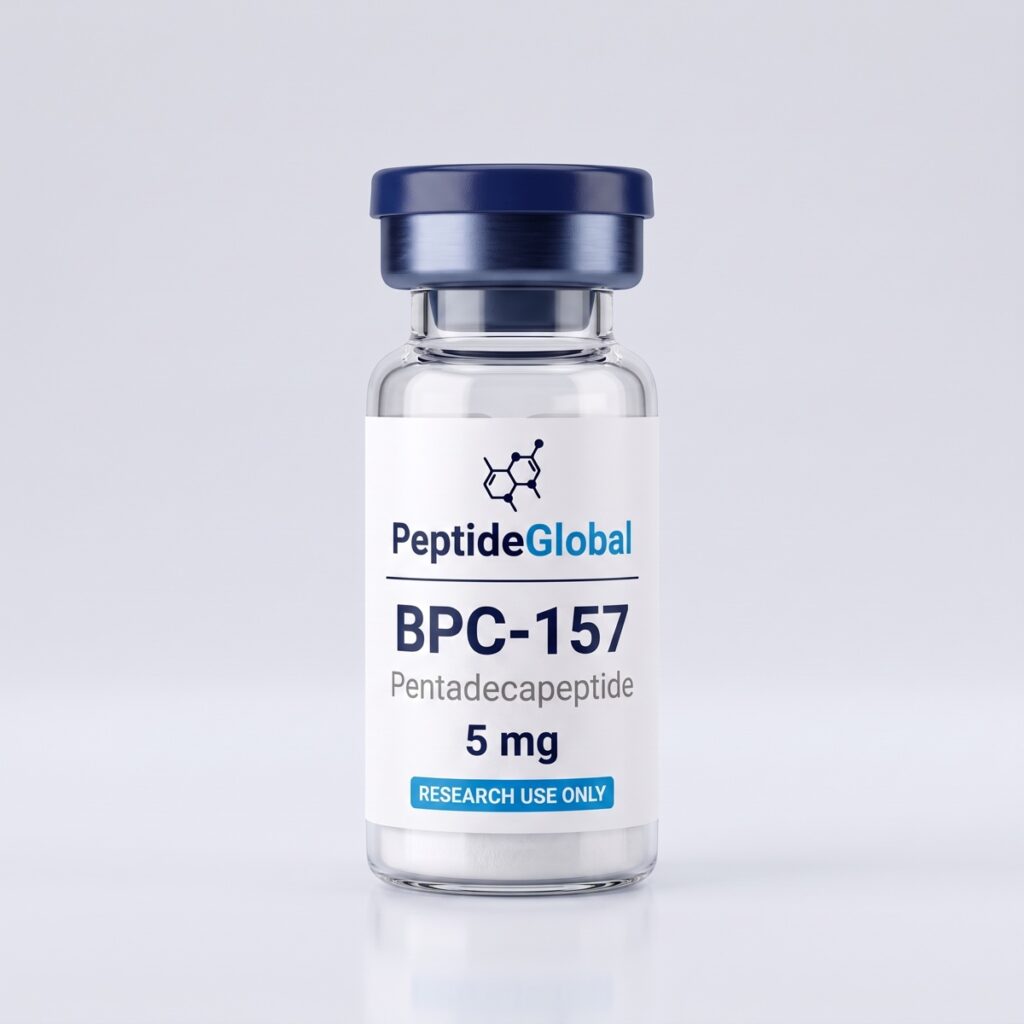
Laboratories studying the BPC-157 sequence in angiogenesis, connective tissue and gastrointestinal models.
No marketing authorisation in any territory. Prohibited in sport under the WADA list. Supplied as a lyophilised research reagent only.
BPC-157 5mg Vial | Pentadecapeptide
Held and dispatched from the UK — cold chain from storage to door Held & dispatched from the UK
5 mg per vial BPC-157 supplied as lyophilised powder in a sealed vial. For laboratory research use only.
- Lyophilised powder, reconstitute before use
- Sealed pharmaceutical pack
- UK delivery £4.95, free over £100
Bulk order & save
100 in stock · ready to dispatch
Same-day dispatch on orders placed before 2pm, Monday to Friday.
Product description
BPC-157 supplied as 5 mg of lyophilised powder in a sealed vial. A synthetic pentadecapeptide of fifteen residues, sequence GEPPPGKPADDAGLV, molecular weight 1419.5 g/mol.
What is BPC-157?
The name stands for Body Protection Compound. The sequence corresponds to a fifteen-residue partial sequence of a protein found in human gastric juice, and the reasoning behind its isolation is worth understanding: gastric mucosa sits in an extremely acidic environment and repairs itself unusually quickly. Researchers at Zagreb pursued the question of what in gastric juice might account for that, and synthesised this fragment.
It is not a naturally occurring peptide in its own right. It is a synthesised partial sequence, which is why the certificate of analysis confirms identity against a reference standard rather than against a biological source.
What the literature actually shows
Published work covers angiogenesis, tendon and ligament models, gastrointestinal mucosal models and peripheral nerve models. Hsieh and colleagues reported effects on VEGFR2 signalling in the Journal of Molecular Medicine in 2017. Chang and colleagues published tendon fibroblast work in the Journal of Applied Physiology in 2011. Sikiric and colleagues reviewed the compound in Current Medicinal Chemistry in 2012.
Two limitations should be stated plainly, because they bear on how results are interpreted. Almost all published work is in rodent models, with no completed human trials of consequence. And a large proportion of the literature originates from a single research group, which means independent replication is thinner than the volume of publications suggests.
BPC-157 and TB-500
These two are frequently mentioned together and are chemically unrelated. BPC-157 is a fifteen-residue synthetic sequence at 1419.5 g/mol. TB-500 is a seven-residue acetylated fragment of thymosin beta-4 at 889.0 g/mol. Different sequences, different masses, different mechanisms in the literature. Studying either in isolation gives interpretable results; studying a fixed-ratio blend of both does not, because an observed effect cannot be attributed to either component.
For that reason we supply both as single-compound vials rather than as a premixed blend.
Price per milligram
This vial is £24.99 for 5 mg, which is £5.00 per milligram. Comparing suppliers on price per milligram rather than headline price is the only like-for-like comparison, because vial strengths are not standardised across this market.
Does it come with a certificate of analysis?
Every batch is supplied with a certificate of analysis stating the batch reference, identity confirmation, chromatographic purity against specification, and the analytical method used. Purity is determined by reverse-phase HPLC with mass spectrometric identity confirmation. The certificate is specific to the batch you receive rather than a generic sample document, and states the laboratory that performed the work.
How is it reconstituted?
Vials arrive as a lyophilised cake under vacuum. Store sealed at −20 °C, protected from light. Allow the vial to reach room temperature before breaking the seal, which prevents condensation drawing moisture into the powder.
Reconstitute with bacteriostatic water directed down the vial wall, not onto the cake. Swirl gently; do not shake or vortex. The 5 mg cake dissolves readily and the solution should be clear and colourless with no visible particulate.
Once in solution, BPC-157 should be kept refrigerated at 2 to 8 °C and protected from light. Avoid repeated freeze-thaw cycles, which degrade peptides faster than steady refrigeration. Reconstituted material is not indefinitely stable and working solutions are best prepared in the volumes actually needed.
Cold chain and UK dispatch
Held at −20 °C from arrival through to dispatch. Orders ship in insulated packaging with a cold pack, tracked, so material spends as little time as possible at ambient temperature. Short transit excursions are normal for lyophilised peptides and do not compromise a sealed vial, but the powder should go back into cold storage on arrival.
Supplied strictly for laboratory research use only. Not for human or veterinary use, and not for diagnostic or therapeutic application. Purchasers must be 18 or over and are responsible for compliance with the rules applying to them.
Specifications
| Compound | BPC-157 |
|---|---|
| CAS | 137525-51-0 |
| Molecular formula | C62H98N16O22 |
| Molecular weight | 1419.5 g/mol |
| Sequence | GEPPPGKPADDAGLV |
| Form | Lyophilised powder |
| Strength | 5 mg per vial |
| Presentation | Sealed glass vial, flip-off cap |
| Purity | ≥98% by RP-HPLC |
| Storage | −20 °C, protect from light |
| SKU | PG-BPC157-VIAL-5 |
Storage and handling
| Reconstitution | Required. Reconstitute with bacteriostatic water before use. |
|---|---|
| Sealed, as supplied | −20 °C, protect from light. Do not freeze. |
| Once in use | Return to refrigerated storage between use. Keep the cartridge upright. |
| Before dispensing | Allow the cartridge to reach room temperature. Do not shake. |
Frequently asked questions
What is the BPC-157 Vial?
The BPC-157 Vial is BPC-157 supplied as 5 mg of lyophilised powder in a sealed vial, for reconstitution in the laboratory at whatever concentration the work requires. It is supplied for laboratory research use only.
How much is the BPC-157 5mg Vial?
BPC-157 5mg Vial is £24.99. UK delivery is £4.95, free on orders over £100, tracked as standard.
What strength is the BPC-157 Vial?
Each vial holds 5 mg.
How is the BPC-157 Vial reconstituted?
Yes. This is supplied as a lyophilised powder, so it is reconstituted in the laboratory with bacteriostatic water added slowly down the vial wall and swirled rather than shaken. The volume added sets the working concentration.
How should the BPC-157 Vial be stored?
Store at −20 °C, protect from light. Allow a sealed vial to reach room temperature before breaking the seal, which stops condensation drawing moisture into the powder.
How quickly is the BPC-157 Vial dispatched?
Orders placed before 2pm are dispatched the same working day, cold-packed in thermal-insulated, tamper-evident packaging.
Is the BPC-157 Vial for human use?
No. Everything supplied by Peptide Global is strictly an in-vitro research compound for laboratory research professionals. It is not for human or veterinary use.

Shipping & handling
- Order before 2pm GMT for same-working-day dispatch
- Tracked UK next-day · tracked EU & worldwide options
- Cold-packed in thermal, tamper-evident packaging
- Thermal-insulated, tamper-evident outer box
Guides on this compound
Reference material on what this compound is, how the format works, and the conditions it is held under. Written for laboratory researchers.
- What is the Wolverine stack? 6 min read
- BPC-157 vs TB-500 5 min read
- What is BPC-157? 5 min read
- What is KLOW peptide? 4 min read