What the Wolverine stack is
"Wolverine stack" is a nickname for one specific pairing: BPC-157 and TB-500 supplied together. It is not a compound, not a formulation and not a standard. It is a shorthand two peptides acquired because they are so often discussed in the same breath, and it names a combination rather than a molecule.
That distinction matters more here than the informality of the name suggests. A supplier who lists a "Wolverine blend" has told you which two peptides are in the cartridge and nothing else — not the ratio, not the mass of either component, not which of the two molecules that share the name TB-500 they mean. Those are separate facts, and they have to be stated separately.
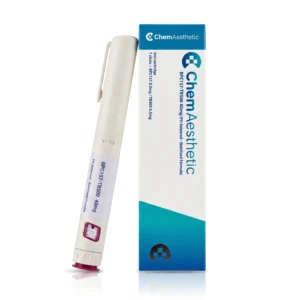
Peptide Global's BPC-157 + TB-500 pen holds 40 mg of total peptide in a 3 ml cartridge, split evenly: 20 mg of each. That is 13.33 mg/ml of total peptide and 6.67 mg/ml of each component. The product is listed under the nickname because that is what people call it, with the component names alongside — the components are what actually identify the contents, and both belong in the name for that reason.
Where the name comes from
The name is borrowed from the Marvel character, whose defining trait is rapid regeneration, and it attached itself to this pairing because both peptides are studied in the context of tissue repair. It is a marketing and forum coinage rather than a scientific one. No pharmacopoeia, standards body or regulator defines it, and no published nomenclature recognises it.
The consequence is that the name travels further than its meaning does. Because it evokes healing, it is also used loosely for other repair-associated combinations that are not this pair at all — sometimes with a third component added, sometimes with a different fragment substituted. Two products both described as a Wolverine stack are not necessarily the same thing, and the only way to know is to read the component list.
The two components
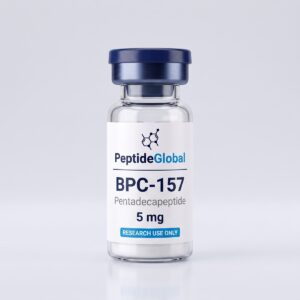
BPC-157 is a fifteen-residue peptide, a partial sequence derived from a protein found in gastric juice. It is studied for local effects at the site it is applied to in a model system — angiogenesis, growth-factor signalling and the behaviour of tendon and ligament tissue in culture and in animal preparations. Its CAS number is 137525-51-0. The full identity is set out in the BPC-157 guide.
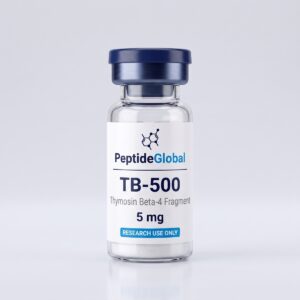
TB-500 is the more ambiguous of the two, and the ambiguity is worth understanding before comparing suppliers. The name is used for two different molecules. What is normally supplied is the acetylated seven-residue actin-binding fragment of thymosin β4, Ac-LKKTETQ, CAS 885340-08-9, with a molecular weight of 889.0 g/mol. The parent protein — thymosin β4 itself — is 43 residues and 4963 g/mol, five and a half times the mass. Both are sold under the name TB-500. The TB-500 guide sets out both identities side by side.
A pairing described only as "BPC-157 and TB-500" therefore does not pin down what is in the second half of the cartridge. That is a property of the nickname, not of any particular supplier.
Why the two are combined
The stated rationale for pairing them is that the published work on each describes activity at a different level. BPC-157 is generally investigated for effects local to the tissue being studied, and TB-500 for effects associated with cell migration and the cytoskeleton, which are not confined to one site in a model organism. Combining them is an attempt to cover both, on the reasoning that the two do not overlap.
That reasoning is a hypothesis about the combination, not a finding about it. The great majority of published work on these two peptides examines them separately. Studies of the pair administered together, in the ratio a fixed blend imposes, are sparse, and a combined preparation is not the sum of two single-compound literatures. Any experimental design that relies on the combination behaving as the two individual profiles predict is relying on an assumption that has not been widely tested.
What the name does not tell you
Three things the nickname leaves open, all of which change what a cartridge can be used for:
The ratio. No standard exists. A 1:1 split by mass is common and is what this cartridge uses, but a supplier is under no obligation to match it and many do not. Two "Wolverine" products with the same total mass can hold quite different amounts of each peptide.
Which TB-500. As above. The seven-residue fragment and the 43-residue protein are different molecules with different masses, and a stated milligram figure means something different depending on which is meant.
The split, when only a total is published. A pen described as "40 mg Wolverine blend" with no per-component figure gives no way to calculate the concentration of either peptide. That is why the split is published here rather than the total alone — without it, the numbers a fixed-ratio cartridge produces cannot be worked out at all.
One further point that follows from the name's sporting associations rather than from the chemistry: TB-500 is on the WADA Prohibited List, prohibited at all times, in and out of competition. BPC-157 is likewise listed. Neither component holds a UK marketing authorisation and no licensed UK medicine contains either.
Handling a two-component cartridge
A pre-mixed two-component cartridge is handled as a single solution, because that is what it is — the two peptides are in the same liquid and cannot be separated by any step available outside a laboratory. Anything done to the cartridge is done to both.
Storage is 2–8 °C, protected from light, and the solution should not be frozen. Freeze–thaw cycling is the failure mode that matters most for a mixed preparation: the two components do not necessarily degrade at the same rate under the same stress, so a cartridge that has been temperature-abused may shift in composition rather than simply weaken, and there is no way to tell by looking. Allow a cartridge to reach room temperature before dispensing and do not shake it.
Storage in general is covered in how to store research peptides, and the trade-offs of fixed-ratio blends against separate single-compound cartridges in blends versus single compounds.
Common questions
What is the Wolverine stack?
It is an informal name for BPC-157 and TB-500 supplied together. The name comes from the Marvel character associated with rapid healing and is a forum and marketing coinage, not a scientific or regulatory term. It names a combination of two peptides, not a compound in its own right.
Which product is the Wolverine stack?
Peptide Global's BPC-157 + TB-500 Peptide Pen. It holds 40 mg of total peptide in a 3 ml cartridge, 20 mg of each component, giving 6.67 mg/ml of each and 13.33 mg/ml in total. It is listed under the nickname with the components named alongside it, because the nickname is what people search for and the components are what identify the contents.
Is the Wolverine stack the same as the Glow or KLOW blends?
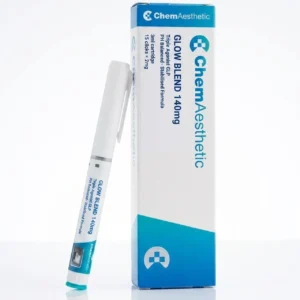
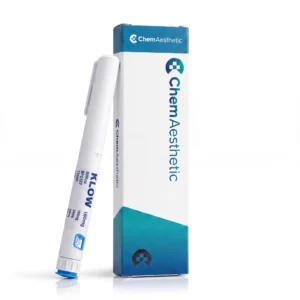
No. Glow holds GHK-Cu, BPC-157 and TB-500, and KLOW adds KPV to those three. Both contain the Wolverine pair but neither is that pair on its own, and their totals and splits are different. The Wolverine pairing is the two-component cartridge only.
Is there a standard Wolverine stack ratio?
No. A 1:1 split by mass is common and is what this cartridge uses, but nothing defines or enforces it. Compare the per-component figures rather than the blend name, and treat two products sharing the name as different preparations until the numbers say otherwise.
Why do suppliers list different TB-500 masses?
Because two molecules are sold under that name. The acetylated seven-residue thymosin β4 fragment is 889.0 g/mol; full-length thymosin β4 is 4963 g/mol. A milligram figure means something different depending on which a supplier means, so it is worth confirming which is being offered before comparing.
Is the Wolverine stack legal in the UK?
Neither component holds a UK marketing authorisation and no licensed UK medicine contains either. Both are supplied for in-vitro laboratory research only, not for human or veterinary use. Both are also on the WADA Prohibited List, prohibited at all times.
Products described in this guide
Supplied for laboratory research use only. UK delivery is £4.95, free on orders over £100, tracked as standard.
Continue reading
Research use only
Every compound named on this page is supplied by Peptide Global strictly for laboratory research use only. Nothing here is for human or veterinary use. These are not foods, supplements or cosmetics, and they are not intended to diagnose, treat, cure or prevent any disease. Nothing on this page is medical, veterinary or legal advice, and no part of it describes administration to a person or an animal.
Purchasers are responsible for their own compliance with applicable law and with the requirements of their institution or ethics committee. At checkout, purchasers confirm they are a qualified researcher aged 18 or over and that they accept the Research-Use-Only Policy and Terms & Conditions.